Home
>
Blog
>
Trends and insights
>
The Anatomy of a Modern Offsite: Data-Driven Insights from our 1,800+ Corporate Retreat Agenda Items
With the rise of remote and hybrid work, the office isn’t the mothership anymore. Instead, teams are coming together in person less often, but with way more intention (and, hopefully, a lot more excitement). Retreats are becoming the main event for building real team culture, getting everyone on the same page, and ensuring people actually feel safe speaking up. Despite their increasingly important role in the fabric of company culture, planning retreats often feels more like following gut feelings, random advice with a dash of ‘that’s how we’ve always done it.’
Turns out, there’s actually a science to this stuff. And what’s science without a little data to back it up?
So, we did what any curious team would do: rolled up our sleeves and dove headfirst into real retreat schedules from our shiny new app. We ended up with 59 retreats, from startups to scaling companies, and nearly 2,000 agenda items to geek out over. Safe to say, we had plenty to chew on.
What we found turns some old-school retreat wisdom on its head. The best offsites aren’t just back-to-back meetings, they actually lean into a healthy work-to-play ratio (for every hour of work, there are 2.46 hours of fun, food, or downtime). The smartest teams plan around natural energy dips, guard weekends like the precious rest time they are, and treat the dinner table like the real MVP. If you want to get the most out of your next retreat, this data-backed guide is for you. Let’s dive in.
To get why modern retreat schedules look the way they do, you have to see how the offsite’s role has changed. Back when everyone was in the same office, culture just sort of happened: random kitchen chats, surprise desk visits, and shared lunches. But in a remote or async world, that “random connection” layer is gone. Now, you have to build culture on purpose, and the team retreat is where the real experiments happen. Which means everything that makes a retreat has evolved too, from how long it lasts to where it is to who is going, what is done there, and when.
We’ve all felt the pain of last-minute changes and those midnight calls when the cab ghosts you, but the data says most company retreats aren’t actually thrown together at the last second. Instead, everything gets planned and locked in weeks, sometimes months, ahead of time.
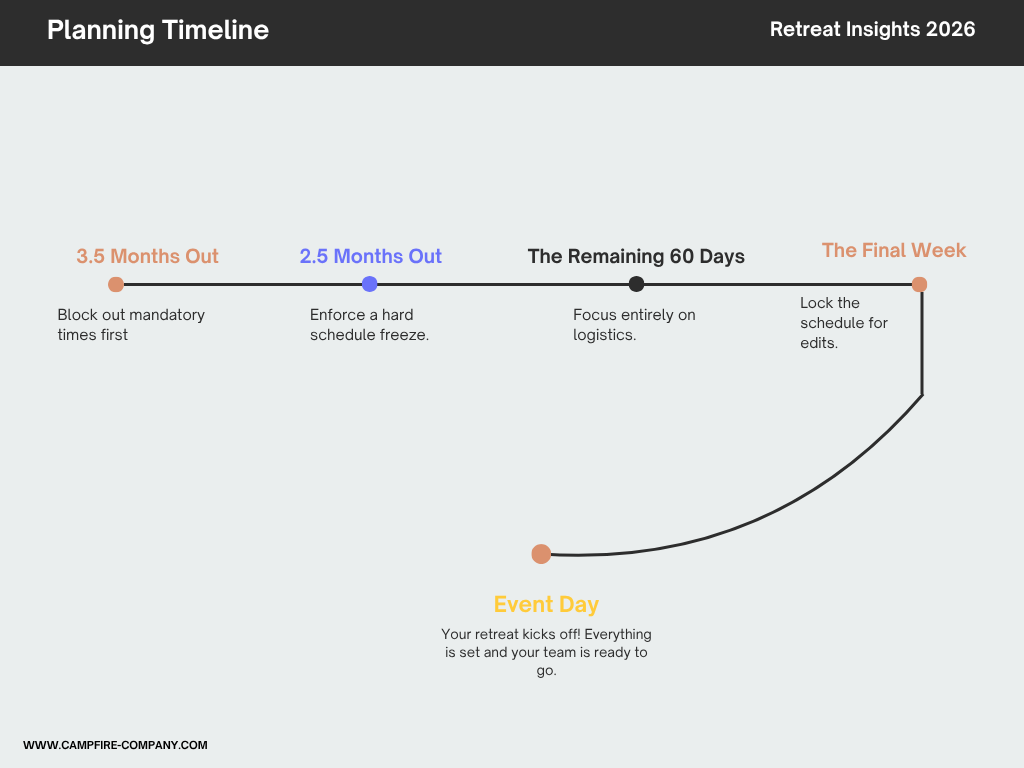
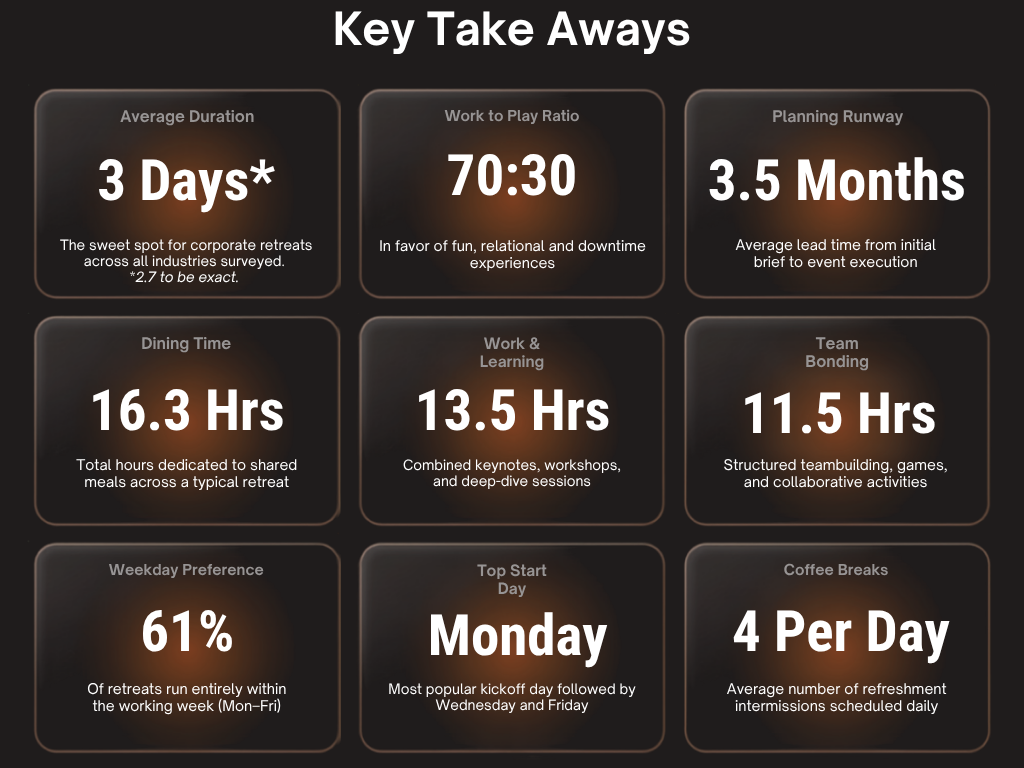
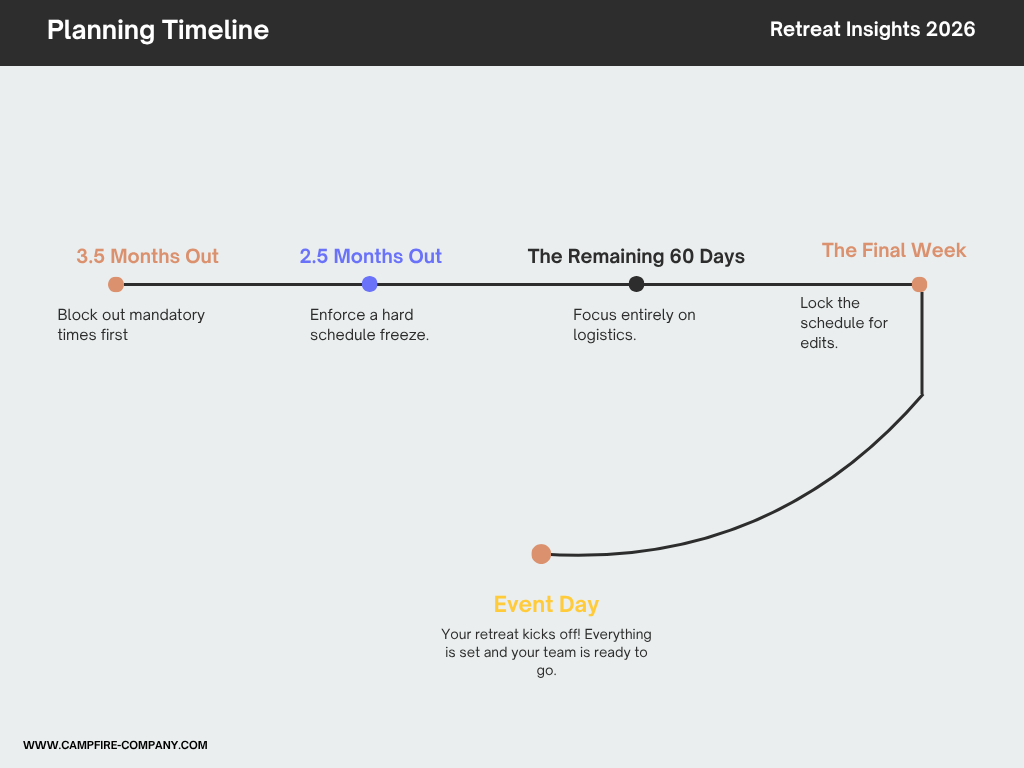
According to the data, planning for a typical retreat starts way earlier than you might think. On average, we’re helping companies sketch out their first agenda items 107.7 days before kickoff, so about 3.5 months out.
At the 3.5-month mark, we’re building the bones of the event. Picking a location is top of the list, but we’re also blocking out time for keynotes, workshops, and meals. This early start is key; it gives us enough buffer to check speaker availability, hire the right facilitator (and not just the available one), coordinate with venues, and map out a realistic schedule before the daily work chaos takes over.
Planning a seamless team retreat requires an operational runway. Stop drowning in spreadsheets, calendar invites, and messy venue emails. We can help lock in your content early, automate your local transfers, and give your employees a mobile-ready itinerary they’ll love.
Get Started: Contact a Campfire Retreat Specialist Today

Getting those agenda items in early is just step one. The data shows that the last real update to any agenda item usually happens 71.9 days before the event, so almost two and a half months out!
Once the schedule is locked in, the game changes. We can stop stressing about what everyone’s doing and focus on how to actually pull it off. This two-month window is all about handling the real-world logistics:
Let’s be honest, whether we are organizers or clients, we’ve all seen those final-week meltdowns where everything changes, and chaos reigns. Maybe that’s why some folks call in the pros. But according to our app data:
That usually just means tweaking a room name or shifting a coffee break by 15 minutes because someone’s flight got delayed. The core of the retreat stays rock solid.
Arriving at an offsite with a stable schedule lowers everyone's anxiety. It allows the organizing team and the attendees to show up relaxed, knowing exactly what to expect.
If you want your next retreat to run as smoothly as the ones in this dataset, you can use these numbers for your own internal deadlines:
How to find the sweet spot: enough time for real connection, not so much that everyone’s counting the hours until they get to go home.
“Time is of the essence” is just a fancy way of saying “hurry up.” These days, everything feels urgent.
If there is one thing that should not be rushed, it is setting up for genuine human connections. When organizing a team retreat, the question of where and when is always: "For how long should we go away?" Of course, a lot comes into consideration here: the purpose of the retreat, the destination, the budget, as well as how many times a year you plan on meeting this way.
When we first launched Campfire, we had assumptions based on our individual experiences.
A single day away from the office can be a nice morale boost, but it usually leaves everyone feeling a bit restless at the end of the day.
On the opposite side of that, more than a week-long getaway always felt a bit much, as lovely as they are; even Kevin from accounting said the idea of being with your colleagues for more than a week can feel a bit overwhelming. It also demands much more logistical adjustment for anyone with partners, kids, pets, plants, and other social engagements.
Most venues have strict check-in and check-out times, so your arrival and departure days are basically for travel, settling in, and getting your bearings. You’ll need half a day to kick things off and set the vibe, and a few hours at the end for closing and a little celebration. In between, you want time for deep work, outdoor fun, bonding, and yes, the occasional cringy icebreaker. Don’t forget to leave space for shared meals, spontaneous chats, and solo recharge time. The magic number? Probably 5-6 days, enough to do it all without getting sick of each other. At least that is what we thought when we were still industry newbies.
Then we looked at the hard data:
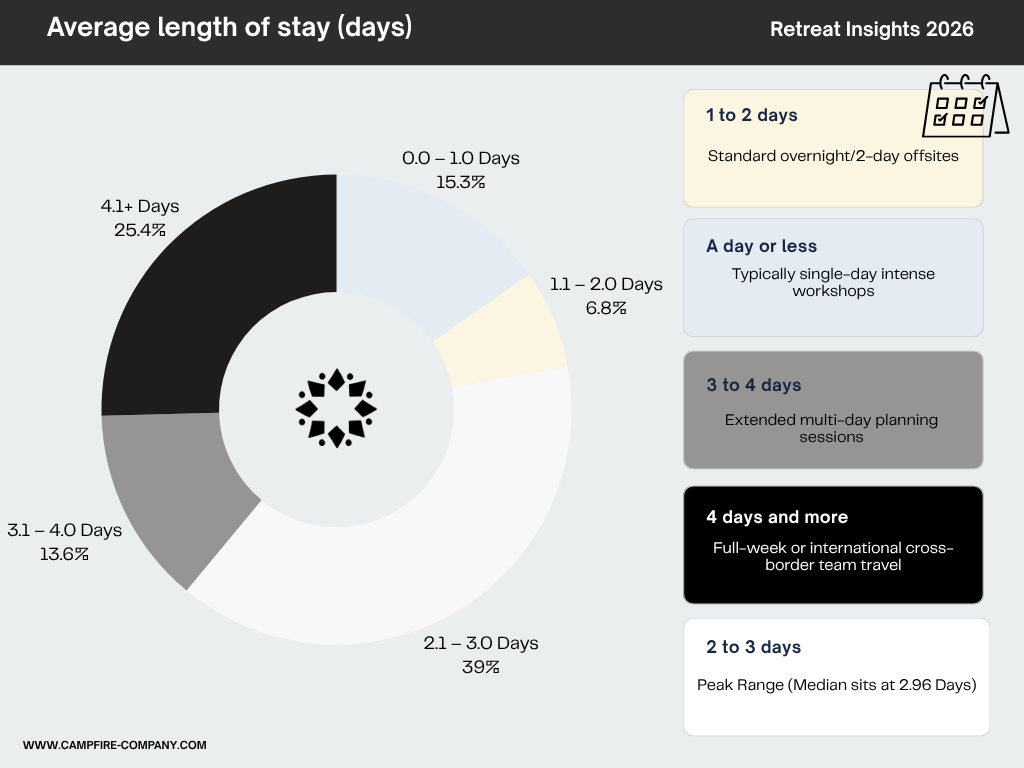
The median retreat length is 2.96 days, so basically three days. Over 75% of retreats wrap up in four days or less. Three to four days seems to be the Goldilocks zone: not too long to cause burnout, not too short to actually get anything done.
Indeed, it is usually around that third day that all the "good stuff" starts to kick in: people are now truly relaxed and comfortable in their new environment, ready to open up and take it all in.
Is 3 days random? We asked ourselves. As it turns out, there is a psychological answer to it. Human beings require time to transition from their day-to-day operational mindsets into a state of open, collaborative reflection. It is called the 3-day effect and was first observed by Ken Sanders, a river rafting guide in Colorado, USA, and then researched by cognitive neuroscientist David Strayer and his team.
Day one is all about transition and decompression. People show up carrying work stress and travel fatigue.
By day two, everyone’s started to settle in and actually enjoy hanging out with their colleagues.
Day three is when it all comes together, and the real magic happens.
By capping the retreat at around three days, you get all the benefits of this psychological arc, without the social exhaustion that creeps in by day five or six, especially for the introverts.
When deciding how long your retreat should be, consider your purpose, your destination, and your agenda. Think about what matters most, and remember: people always take longer than planned to get from A to B, finish lunch, or board the bus.

Heading out Friday after work and rolling back in Monday morning might look practical on paper, but for a lot of people, it’s a nightmare, goodbye, weekend downtime; hello, social energy marathon.
Demanding that your employees sacrifice weekends for "forced fun" isn’t the best way to build a healthy company culture. Modern, empathetic companies build their offsites directly into regular billable company time.
Back in the day, companies loved to schedule offsites over weekends to avoid losing 'billable hours.' The hidden cost? Employee resentment and burnout.
Our aggregate analytics indicate that the modern corporate world has executed a major ethical and structural shift away from this practice.
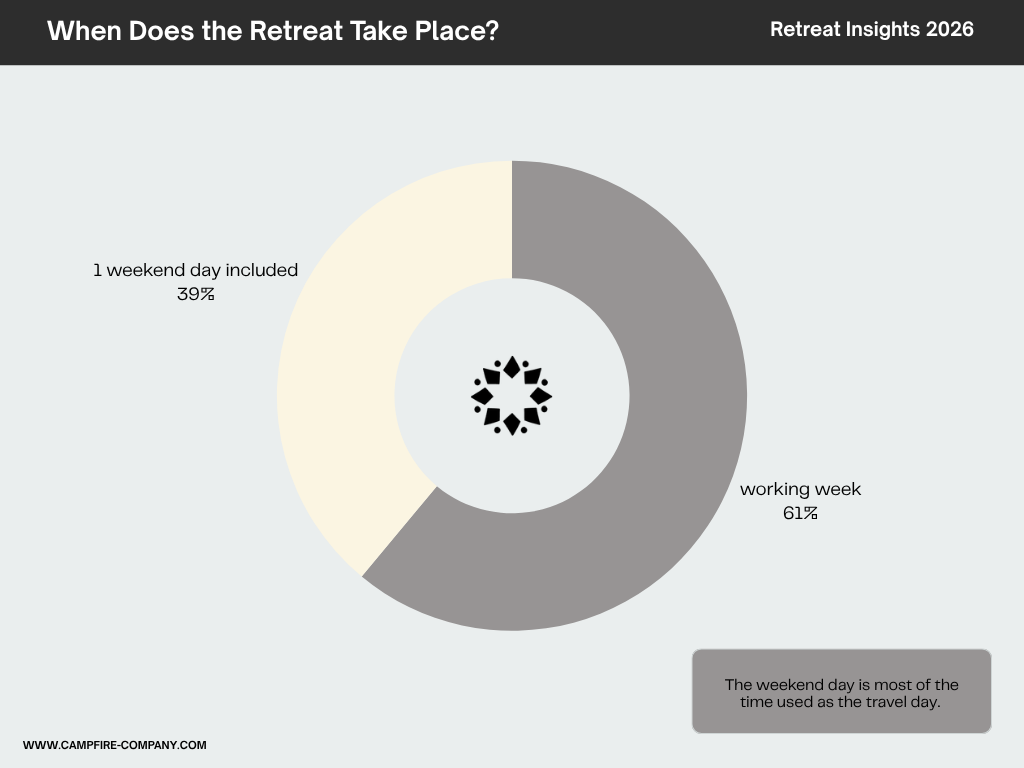
Most retreats, 61%, happen entirely during the workweek (Monday to Friday). Only 39% touch a Saturday or Sunday, and even then, it’s usually just for travel, not actual programming.
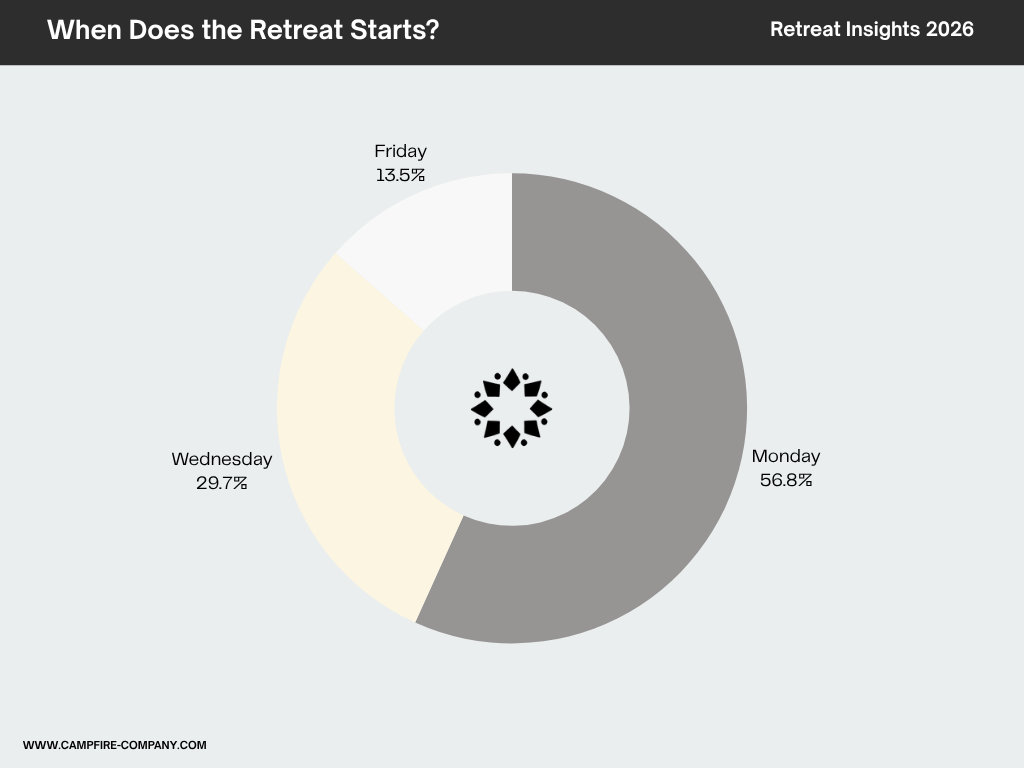
When we look at the specific days of the week that corporate retreats begin, the trend toward protecting personal time becomes even more evident:
Monday is the most popular day to kick off an offsite, with Wednesday coming in second. The classic mid-week sprint lets teams finish their own work early in the week, gather in the middle, and wrap up before the weekend. Friday? Least popular for starting anything (except a relaxing weekend, of course).
By skipping weekends, companies send a clear message: we respect your personal life and boundaries. Team connection is work, so we’ll do it during work hours. When people don’t feel like their free time is being hijacked, they show up with more energy, enthusiasm, and are way more likely to actually participate.
Your agenda is your lifeline, and it should be a living document: adaptable, purposeful, and built for both business results and real human connection. If you remember three things, make it these: intentionality, flexibility, and balance.
We have already written a piece about the ultimate team retreat agenda but let’s go over the main points here again.
Before you do anything, this is what you need to get right and share with the group well in advance.
Priya Parker, our inspiration for anything related to group gathering, says it best. Events start before they begin. From the moment you send out that invitation to join, your retreat has somehow begun, and the tone is being set.
It is important to allow enough time for travel, of course, but also to let everyone arrive, settle in, check in, and mingle informally.
Remember, some people have been traveling for hours, so have water and snacks ready. If bedrooms aren’t available yet, make sure there’s a spot to drop bags, freshen up, and rest.
Some event organizers recommend against starting with “housekeeping,” but we quite like it. It prevents the opening address from being interrupted by people trying to connect to the Wi-Fi or looking for the toilets.
Make sure everyone knows where the essentials are, so you can get to the good stuff without distractions.
Always welcome people. Even if you’ve traveled together. And use that time to remind everyone of the goals and desired outcome. Remember, the way you address the group at that moment will set the tone for the rest of the offsite.
To keep people excited and on their toes, think about how you can mix different styles. Workshop, breakouts, keynotes, creative sessions…
When it comes to the “fun” bit, focus on a few key elements:
Summarize key insights and lessons learned, and outline follow-up initiatives and next steps to avoid losing momentum once everyone is back at the [home] office.
Mention logistical information about check-out and travel, but do not close with housekeeping. The last impression is what they will carry home with them. It is best to end with a special celebration or shared moment.
The distribution of these activities across our study demonstrates a multi-dimensional approach to agenda construction. It shows a clear understanding of team dynamics: the modern offsite is an exercise in managing cognitive load and psychological energy. Rather than over-indexing on pure work output or pure recreation, organizations are designing integrated ecosystems that blend professional development with social cohesion.
Stressed about balancing your own itinerary? You don't have to guess how to space your workshops, local transfers, or team-building blocks. Let us build a perfectly balanced, data-backed agenda for your team. Build Your Custom Retreat Agenda with us.
Old-school offsite planning usually means cramming as many hours as possible into meeting rooms, just to make the finance team feel better about the budget.
But the best teams? They flip that script completely.
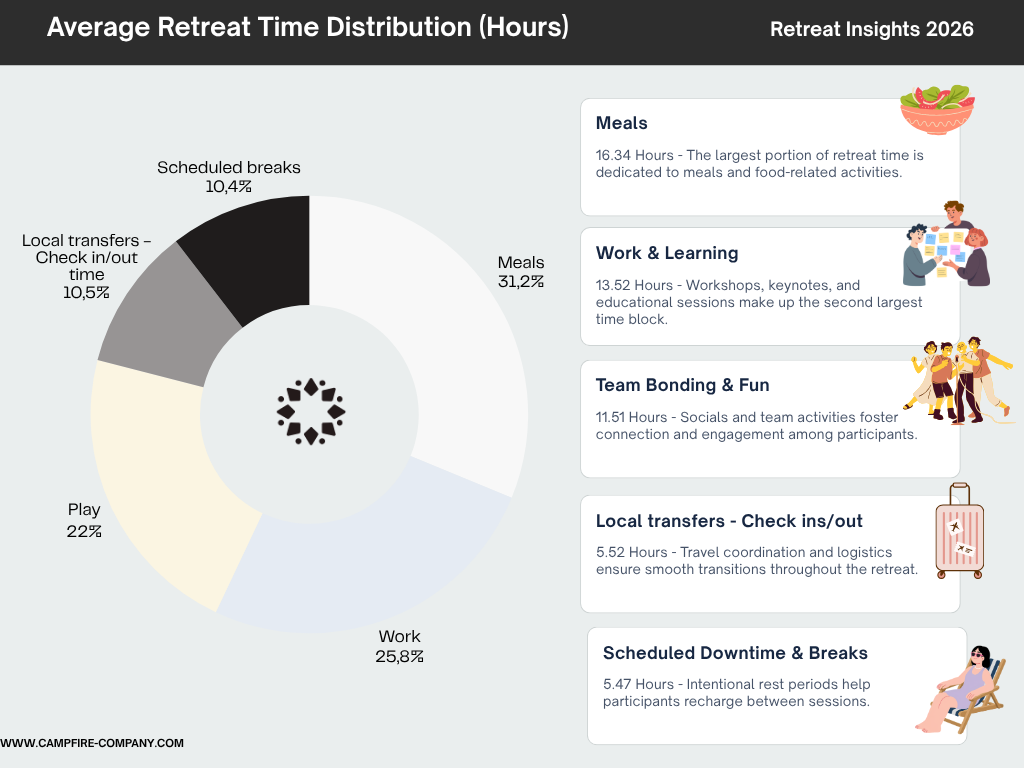
Let’s look at the data per category of activity:
Teams spend an average of 5.52 hours per retreat on logistics and travel. A quick and important note: this does not track the external flights or trains to get to the host city. This tracks the cumulative time spent on internal group movement: a 2.3-hour arrival/check-in buffer on Day 1, a 1.9-hour check-out/departure block on Day 3, and 30-60-minute bus shuttles moving the group to offsite dinners and activities.You have to plan for the chaos of moving a big group. Herding your team through a hotel lobby or onto a bus always takes longer than you think.
For every hour of official work, teams are clocking nearly two and a half hours of eating, hanging out, and just being human. An average retreat features 13.52 hours of structured work/learning vs. 33.32 hours of non-work programming.
Retreats aren’t just about changing the scenery. The real value is in building trust and real connections, and that only happens when you actually give people time to connect.
Here’s a fun fact: teams spend more time eating together than doing anything else. Meals take up over 16 hours per retreat, beating out work sessions by almost three hours.
Dining takes up the single largest block of time on a retreat (16.34 hours total). Breakfasts average 1.55 hours, lunches average 1.39 hours, and dinners stretch from 2.17 hours (Gala format) to a massive 3.36 hours (Standard format).
Long, laid-back meals do more for team bonding than any PowerPoint ever will. Real conversations at the dinner table break down walls fast. In a meeting room, communication is usually top-down. At the dinner table, people naturally break into small groups and have real conversations. An engineer might finally chat with a product manager they barely know, or a junior designer might share a laugh with the VP of Operations. These unplanned moments break down silos in ways no formal team-building exercise ever could.

Big-picture planning is great, but the real magic is in the details: how you actually lay out the hours in a day. People can only focus for so long before their brains tap out.
Our dataset shows that companies are remarkably synchronized in how they navigate human energy cycles, showcasing an unwritten industry consensus around two key design patterns:
When analyzing the start times of items categorized under “Team Bonding & Fun,” we observed a sharp, highly concentrated spike in activity.
The data shows that the absolute peak hour for starting structured team activities is 16:00 (4:00 PM).
There’s a reason for this: few of us do our best thinking at 4:30 PM after a full day. The late afternoon is a productivity dead zone, so trying to run a big strategy session is just asking for glazed eyes.
Instead, the most successful retreat agendas call it a day at 4:00 PM. They wrap up the laptops, vacate the seminar spaces, and move directly into active, experiential team bonding. These activities have an average duration of 2.16 hours (approx. 2 hours and 10 minutes), perfectly occupying the late afternoon window and transitioning the team seamlessly into the evening dinner block around 6:15 PM or 6:30 PM.

Another vital micro-scheduling element is the design of the coffee break. In many legacy agendas, breaks are treated as an afterthought, a quick 10 or 15-minute gap to run to the restroom and grab a paper cup of drip coffee.
In reality, a standard coffee break with us lasts exactly 35 minutes. Fifteen minutes is barely enough to breathe. Thirty-five minutes? Now you’ve got time for introverts to recharge and extroverts to actually talk about what just happened.
The Campfire dataset paints a very different picture of the modern offsite break:
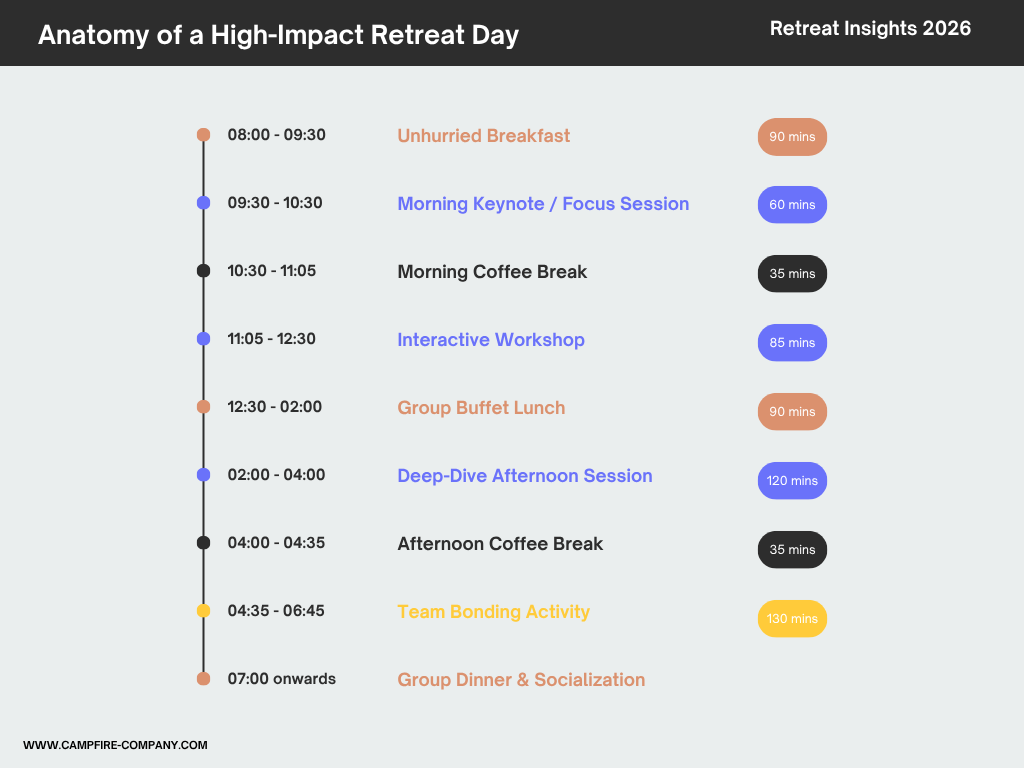
Putting these 35-minute breaks at 10:00 AM and 4:00 PM keeps everyone fresh and gives space for those spontaneous, brilliant ideas to pop up.
99.5% of individual agenda items are customized for subgroups rather than marked as mandatory for everyone.
Modern offsites are all about personalization. Instead of locking 100 people in one room for days, organizers let teams break out for focused sessions, then bring everyone back together for the good stuff.
For corporate leaders and retreat planning committees, the aggregate data from our application yields an actionable, step-by-step design framework for building an impactful offsite agenda.
Don’t try to squeeze your retreat into one night or drag it out for a week. Three days and three nights are the sweet spot: enough time for everyone to settle in, connect, and avoid burnout.
When you’re reviewing your agenda, check how much time is spent in meetings versus actually hanging out. If work sessions are taking over, start cutting them. The real magic happens outside the boardroom.
Don’t rush meals. Give breakfast at least 1.5 hours and dinner a solid 2.5 to 3 hours. Go for buffet or family-style setups so people can actually mingle and chat, not just sit in one spot.
Give everyone’s brain a break by ending all the heavy stuff by 4:00 PM. Kick off your main bonding activity right then—city tour, cooking class, you name it. Keep it to about two hours so there’s time to freshen up before dinner.
Check your schedule: add real 35-minute coffee breaks at least at 10:00 AM and 4:00 PM. Make it clear these aren’t just for email, they’re for decompressing, chatting, and actually connecting.
Respect everyone’s boundaries: keep the retreat Monday to Friday. Start on a Monday or Wednesday so people don’t have to give up their weekend to hang out with coworkers.
The numbers don’t lie: offsites have changed. The best companies know you can’t force a real connection, and you definitely can’t make it happen with a jam-packed agenda that feels like just another day at the office. When leaders build agendas that respect people’s energy and boundaries, and make space for real connection, especially over dinner, retreats actually change things. In a remote world, time together matters. The companies that get this will build stronger cultures, keep their best people, and create teams that actually trust each other.
Ready to Design Your Perfect Team Retreat?
At Campfire, we help distributed and hybrid teams design, organize, and execute seamless corporate retreats that stick to the data-backed principles of top-performing companies. Let us handle the heavy lifting so you can focus on connecting with your team. Tell us about your team size and goals, and let's plan your next Campfire together.
From practical insider warnings to new secret locations, get our monthly, genuinely spam-free newsletter.
Subscribe now
The Architecture of Psychological Safety: Why Workplace Mental Health Needs a Physical Reset
Read more


