Discover actionable insights on fostering a workplace culture that inspires and engages—trusted by over 24,000 subscribers worldwide.
Thank you! Your submission has been received!
Oops! Something went wrong while submitting the form.
Time to plan a company offsite. Whether you’re a seasoned pro or this is your first time wrangling calendars, it’s a big deal: offsites and team retreats are real drivers of company strategy.
Tempted to ask Google or ChatGPT what to do next? Fair enough. But how about advice from people who actually organize, host, and facilitate these things in their sleep? We’ve got you. Here’s our master FAQ, covering everything from ROI to activities, agenda, and venue hunting. Just jump to the category relevant to you right now.
Corporate Offsite ROI & Goals
1. How do you measure the ROI of a corporate offsite?
That’s usually the first question you’ll hear (or ask yourself): Why are we spending money on this? What’s the actual return? You’ll want some solid facts in your back pocket, so we’ve rounded up a few for you:
As a company, your most valuable (and expensive) asset is your team. You want that asset to perform as well as possible. And for that, they need:
a. Good mental health
Research shows that employees with good mental health are more focused and productive, reducing errors and increasing efficiency. According to The World Health Organization for every $1 invested in mental health treatment, there is a $4 return in improved health and productivity!
b. Solid Trust
Trust in a team leads to better collaboration and communication, better morale, and something we can all measure (well, researchers did), more productivity and more engagement. A lot more, respectively 50% and 76% more according to Edelman Trust Barometer in 2020.
Increased trust also boosts productivity and creativity, according to an article from Society for Human Resource Management (SHRM): highly trusted workplaces enjoy 50% more productivity and when there is more trust in the workplace, employees are 23% more likely to come up with ideas and solutions.
Trust also reduces stress! The American Psychological Association (APA) found that employees in high-trust organizations have 74% less stress and 13% fewer sick days.
c. Great Collaboration
According to the market research firm Frost & Sullivan, a team that collaborates well can increase innovation by 30%. A 2022 Alludo report shows that about 64% of workers say they lose at least 3 hours of productivity per week due to poor collaboration!
d. Strong Engagement
Disengaged employees cost organizations an estimated $8.9 trillion annually in lost productivity, a figure that has nearly doubled since pre-pandemic years. Teams with high engagement don't just feel better; they perform better. Workplaces with higher trust enjoy 50% more productivity and are 76% more engaged. Engaged employees are 21% less likely to quit (in high-turnover companies, according to Gallup). High-trust organizations also benefit from 74% less stress and 13% fewer sick days. Teams that share real experiences get more comfortable with each other. Those memories outside the usual work setup become a reminder that everyone’s in the same boat when things get tough.
The good news is, team retreats can actually boost mental health, trust, engagement, and collaboration. But for that to unlock, the retreat needs to be thought through from beginning to end, leaving nothing to chance, except for the beautiful serendipity interactions of the purposely unplanned moments, of course.
2. What are the main objectives of a company retreat?
The Strategic Planning retreat is designed to tackle the pivotal questions that shape purpose-driven leadership and collaborative success.
b. Culture& Team Building
With the traditional office now more myth than reality, team-building retreats give teams a rare chance to do something wild: actually enjoy being together.
c. Leadership
Things are changing fast. Staying on track and knowing how to empower your team demands work and commitment. Leadership retreats are a solid way to stay aligned, work on strategy, and get real guidance from coaches and facilitators.
d. Training & Learning
Learning something new is exciting, but it can also be draining. Taking a course or launching a new project in a beautiful natural setting together as a team is a great way to start on the right track!
e. Crisis& Resilience
When a crisis hits, the instinct is to hunker down and focus on the chaos. But sometimes, stepping out into nature with your team is exactly what builds resilience, sparks creative problem-solving, and strengthens bonds in ways the office just can’t.
f. Incentive
Launching something new, hitting a milestone, celebrating a win, or even bouncing back from a big mess-up.
There’s always a reason to get the team together. And of course, there are plenty more: sales kickoffs, onboarding, innovation sprints, you name it. The 'wrong' reasons aren’t really wrong; getting together is always a good idea. Usually, it’s just a lack of clarity or fuzzy language.
Pitching to the CEO can be a walk in the park or a full-on negotiation, depending on your company’s vibe. Here’s how to make it smoother.
a. Lead with the Business Case
Don't start with the location or the activities. Start with the problem the retreat will solve or the strategic goal it will achieve.
Align with company goals by tying the retreat to a major milestone or strategic shift.
Address a pain point: If employee retention is down, burnout is high, or cross-department communication is lagging, frame the retreat as a targeted intervention.
Define clear metrics: Give the CEO specific outcomes. For example, "The goal is to finalize our 2027 roadmap and complete a hackathon."
b. Present a Multi-Tiered Budget
Most CEOs will pass on a proposal with just one big price tag. Give them three clear options so they feel in control of the spend.
Minimalist budget for a local location: 1-2 days, intensive work sessions.
Intermediate (ideally the one you want to go for): at least 3 days, short flights, half work, half team building
All in: Destination retreat, at least 4 days with full agenda and catering.
c. Detail the Logistics and Mitigate Risks
Anticipate the CEO’s operational concerns.
“What about the day-to-day work?”: Explicitly state how daily operations will be maintained. For example, schedule it during a historically slow week, or split the team into two shifts so customer support never drops.
“Are we just going there to chill?”Show that the schedule balances real work with team-building. A 50/50 split between business and fun is usually the easiest sell, even if 30/70 is actually better (but you can always explain that later).
“I don’t have time to plan this”: Don't ask the CEO to research. Bring in your retreat partner if you are using one or two specific locations or venues for each budget tier that have already been vetted for reliable Wi-Fi, meeting spaces, and accessibility.
4. How to pitch a company retreat to the Team?
Pitching a retreat to your team is a whole different game. The CEO cares about ROI; your team cares about their time, comfort, and having a say.
Here is how to pitch the retreat to the team to get genuine buy-in and minimize resistance.
Don’t pretend a retreat isn’t a disruption. Call it out up front; it builds trust.
Give massive lead time: Announce the dates at least 2 to 3 months in advance. This gives parents and caregivers ample time to arrange support.
Set clear expectations: let everyone knowdaily deliverables will be paused or scaled back during the retreat. No one should feel like they’re paying a work penalty for showing up.
Focus on what the team actually gains from the experience, rather than what the company gains.
The human element: Frame it as a chance to see coworkers as actual people, not just avatars on a screen.
Career and Influence: Position the strategy sessions as a rare opportunity for them to have a direct voice in the company’s future direction, away from the day-to-day grind.
Perks and comfort: Hype up the venue, the food, and any unique local experiences. People want to know what’s in it for them.
To lower anxiety for introverts or those protective of their personal time, establish clear boundaries when you announce the event:
Opt-In Socials: Make it clear that while daytime strategy sessions are mandatory, evening socialization is largely optional.
Guaranteed Downtime: Build structured "free time" into the agenda where people can rest, exercise, or call home without guilt.
Private spaces: If the budget allows, give everyone their own hotel room. Nothing kills retreat vibes faster than making adults share rooms with coworkers. If that’s not possible, at least make sure the rooms are spacious and comfortable enough so no one feels like they’re back in a university dorm.
If someone tells you they really can’t (or just don’t want to) go, handle it with empathy, not enforcement.
Listen to the root cause: Is it anxiety? Caregiving?
Have a backup plan: If an employee genuinely cannot attend due to personal circumstances, do not penalize them. Create a clear plan for how they can contribute to the strategic workshops asynchronously from home, and ensure they don't feel excluded when the team returns.
Logistics, Budgeting & Planning
1. How Much Does a Corporate Retreat Cost per Person on Average?
A baseline European retreat runs €250-€450+ per person per night, but don’t stop at the room rate.Your real budget should include flights, seasonal venue costs, and event management fees, so you don’t get hit with last-minute financial surprises.
The True Cost Breakdown (Per Person / Per Night)
To build a bulletproof business case for your leadership team, you cannot focus solely on hotel room costs.
You’ll want an all-in estimate: accommodation, food and drinks, workspace hire, a team activity, and event management if you’re bringing in help.
The Essentials Tier (€250 – €350 / $270 – $380): Best for execution-focused alignment. This structures your retreat around high-quality regional or countryside venues (typically within a 2-hour ground-transit radius of major hubs such as London, Amsterdam, or Munich), focused local catering, and single-track team-building activities.
The Elevated Tier (€350 – €450 / $380 – $490): Best for scaling cultures. This unlocks premium boutique properties, versatile multi-room workshop venues with advanced AV setups, private dining or enhanced gastronomy, and professionally facilitated team experiences.
The Luxury Tier (€450+ / $490+): Best for high-stakes leadership alignment or landmark company milestones. This covers exclusive venue buyouts, 5-star properties in premium international destinations (e.g., the Lisbon coast or Alpine design lodges), and complex multi-track production.
The Three Hidden Variables That Shift Your Tier
If you want to stick to the Essentials or Elevated tier, keep an eye on these three things; they can blow up your budget fast:
a. Destination vs. Transits
A venue might look cheap, but if it needs a three-hour coach ride for 100 people after landing, your transport costs will skyrocket. Always check the total cost to get from your front door to the venue door.
b. The Shoulder-Season Advantage
Booking a Mediterranean coastal retreat in July means paying peak travel prices. Run that same event in late September or October, and you’ll see room rates drop by 30% to 40%, with the same high production value and (usually) the same great weather.
c. Program & Facilitation Complexity
Standard peer-led workshops utilize the main meeting space included in your base tier. However, if your program requires external keynote speakers, specialized psychological safety facilitators, or many breakout rooms, the venue's day-delegate rates (DDR: a per-person pricing package offered by venues for meetings and conferences) and AV production charges will scale accordingly.
2. How to plan a corporate retreat step-by-step?
Phase 1: Setting Your Goals & Budget (24–16 Weeks Out)
Get aligned early, especially if you have a larger team (100+ people).
Pick One Clear Focus: Decide exactly why you are gathering. Is it to work on next year's strategy, build closer team bonds, or celebrate a big milestone?
Set Your Price-Per-Person Limit: Decide which budget tier fits your team: Basic (€250–350), Mid-Range (€350–450), or Premium (€450+) per person, per night.
Find the Ultimate Decision-Maker: Make sure you know exactly who needs to sign the contracts and approve the final spending (like your CEO or CFO) so there are no delays later.
Check the Travel Time: Look at where everyone is starting from. Find a destination that is centrally located and easy for most of the team to reach via direct flights or trains.
Lock the Dates: Pick 2–3 mid-week options (Tuesday–Thursday is your friend if you want to protect everyone’s weekends).
The critical step for mid-sized teams (30–150 people) to secure exclusive buyouts at hotels or resorts.
Send Inquiries to Venues: Ask hotels if they have enough bedrooms, a meeting room large enough for the whole team, and smaller quiet spaces for group work.
Double-Check the Booking Rules: Read the fine print before signing. Make sure the hotel contract allows you to drop your room count by 10% to 15% without a financial penalty if team members can no longer make it.
Watch Out for Hidden Fees: Check the contract for extra costs like mandatory fees for bringing your own wine (corkage), meeting room equipment rentals, or early noise curfew fines.
Sign the Contract & Pay the Deposit: Sign the hotel agreement and set up the payment schedule with your finance team.
Book Main Flights & Trains: Buy group travel blocks or have employees book their primary routes early to secure seats and keep ticket costs low.
Phase 3: Building Your Schedule & Guidelines (12–8 Weeks Out)
This is the perfect starting runway for smaller teams of under 50 people.
Schedule Your Day in Waves: Keep morning sessions focused on brain-heavy tasks when energy is high. Move physical, creative, or collaborative tasks to the afternoon.
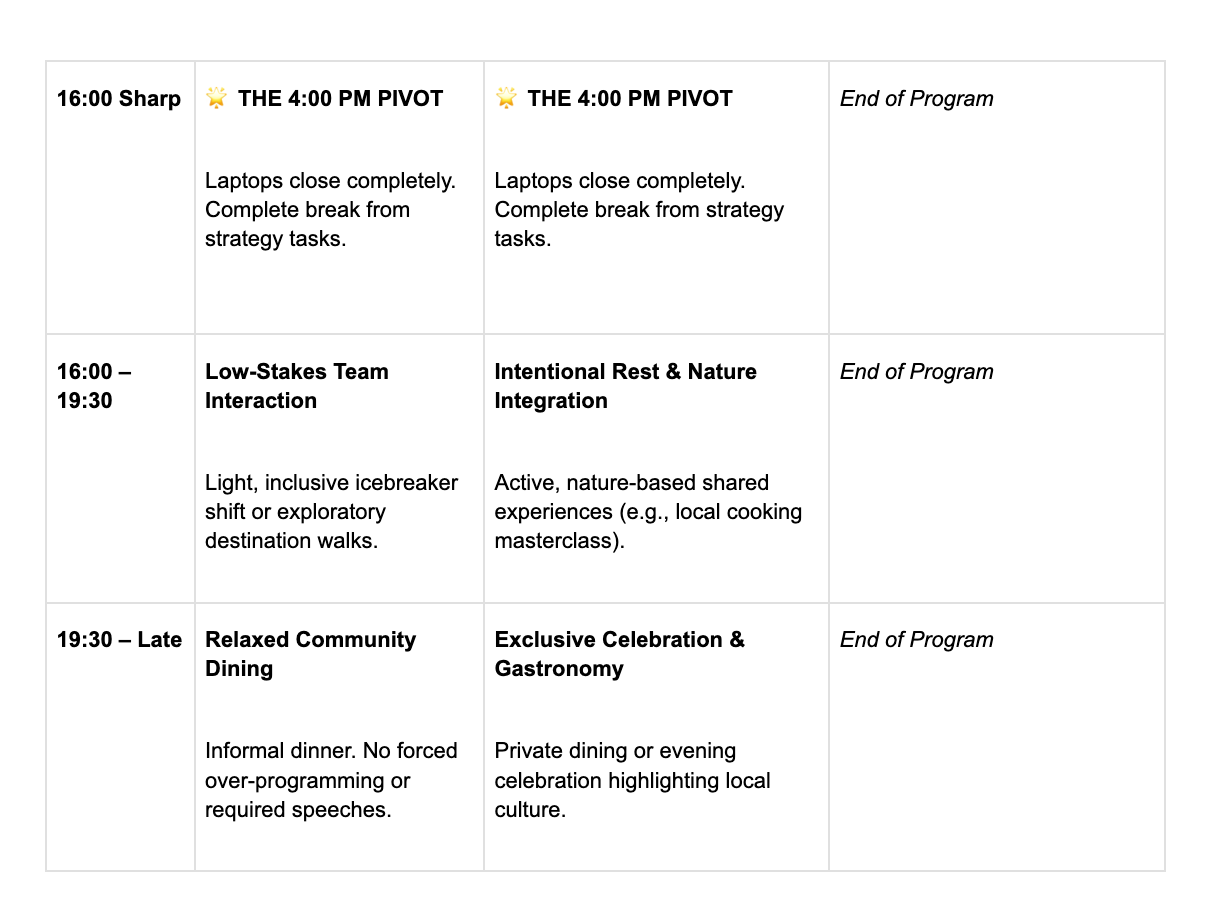
Enforce the 4:00 PM Pivot: Hard-stop all presentations and work sessions at 4:00 PM sharp. Plan light, low-pressure activities or downtime for the late afternoon.
Pick inclusive activities: Choose team-building events where bonding doesn’t depend on alcohol, and make sure they’re accessible and comfortable for everyone. Don’t forget the introverts; build in quiet recharge spaces and keep late-night mixers strictly optional.
Write a Simple Code of Conduct: Outline a basic company policy covering expected behavior, expense rules, and mutual respect during the trip.
Phase 4: Gathering Details & Final Preparation (8–4 Weeks Out)
The final stretch of the month is all about gathering individual details.
Send Forms: Ask your team to fill out a simple form sharing their pre-booked flight details, emergency contacts, accessibility needs, and food allergies.
Group the Airport Shuttles: Match people who land at similar times so they can share buses or taxis to the venue together.
Send Pre-Event Packing Lists: Give the team clear tips on what to wear, weather forecasts, a basic overview of the destination, and the final schedule.
Lock the Menu Plan: Review the food options with the venue, ensuring they have set aside completely separate plates and clear alternatives for those with severe allergies.
Give the photographer a checklist: Tell your media team exactly what you want, focus on raw, candid moments of people laughing and working together, not stiff, posed headshots.
Phase 5: On-Site Execution (The Event)
Keep the logistics running smoothly behind the scenes.
Run a Morning Tech-Check: Test microphones, projectors, presentation slides, and video links for any remote attendees at least two hours before the first session starts.
Set Up a Quick Messaging Channel: Create a dedicated Slack channel or WhatsApp group just for the internal organizers to coordinate in real time.
Do a Daily Check-In with Venue Staff: Meet briefly with the hotel’s kitchen and event manager each morning to confirm the day's timings.
Watch the Energy in the Room: Keep a close eye on your team's fatigue. If a workshop is running over, step in to protect break times and keep the schedule on track.
Phase 6: Keeping the Momentum Going (0–2 Weeks Post-Offsite)
The real value of a retreat happens in the weeks after you get back.
Send the Feedback Survey: Send out an anonymous survey within 48 hours of returning to get the most honest, accurate feedback while the event is fresh in everyone's minds.
Share What You Built: Put together the workshop notes, key decisions, and new company goals in a shared online space where the whole team can access them.
Share the Highlights: Publish the photo gallery internally and work with your marketing team to turn the highlight video into an employer branding asset for social media.
Settle the Final Invoice: Double-check the hotel's final invoice against your original contract quotes before sending the final payment.
Planning a seamless corporate retreat means juggling hundreds of moving parts across multiple departments. This checklist distills European offsites into a step-by-step playbook, so you don’t have to learn the hard way.
When you start looking at hotel or resort spaces, don't let beautiful bedroom photos distract you. A great vacation hotel doesn't always make a great corporate retreat venue. Always check these four practical details:
Exclusive Buyout Potential: For mid-sized teams, see if you can rent out the entire property. Owning the space lets your team speak freely about strategy without worrying about other hotel guests hearing them, which builds a strong sense of psychological safety.
Flexible Workshop Spaces: Make sure the main meeting room fits everyone comfortably, but also look for smaller rooms or outdoor spaces for breakouts. And yes, excellent Wi-Fi is non-negotiable.
Dietary & Kitchen Flexibility: Ensure the venue's kitchen team is fully comfortable handling severe allergies and distinct dietary choices seamlessly.
Transit Proximity: Check how far the venue is from the nearest airport or train station. If a hotel looks cheap but needs a 3-hour bus ride to reach it, you’ll lose a full day just getting there.
3. City vs. Countryside Retreat: Which is Better?
Choosing between a city center and a countryside estate comes down to the primary goal of your offsite:
Choose a City Retreat if: Your primary focus is team celebration, exploration, and tapping into a vibrant cultural scene. Cities are great for short, high-energy trips because transport links are effortless, and you have hundreds of external dining and entertainment options right outside your door.
Choose a Countryside Retreat if: You want deep focus, strategic reflection, and to rebuild social bonds across a distributed team. Countryside spots strip away distractions, keep everyone together for meals, and naturally encourage those casual, late-afternoon strolls and real conversations.
Vendor & Agency Selection
1. Full-Service Retreat Planner vs. DIY: Choosing Your Approach
2. Full-Service Retreat Planner vs. DIY: Pros and Cons
To make the right choice for your upcoming event, you need to weigh your team’s internal bandwidth against the structural complexity of your retreat.
3. The Do-It-Yourself (DIY) Approach
The Pros: Complete, direct control over every tiny detail and no external management fees. Perfect for tiny squads or close-knit startups who are traveling locally and staying under one roof.
The Cons: It’s a massive time sink. Organizing an offsite can easily eat up 80 to 120 hours of your EA or HR lead’s time, pulling them away from their actual jobs. DIY also means you’re on your own if a vendor drops out or a flight gets canceled.
4. The Full-Service Agency Approach
The Pros: Complete peace of mind and huge time savings. You get access to trusted European venues, better room rates, and event pros who handle everything on the ground. If something goes sideways, the agency owns it and fixes it, fast.
The Cons: You’ll need to budget for event management fees. For tiny, single-team day trips, it might feel like overkill.
Questions to Ask a Corporate Retreat Agency Before Booking
If you decide to interview a corporate retreat planner or agency, use these 6 practical, direct qualifying questions to make sure they are the right fit for your business:
"What is your sweet spot when it comes to team sizes?"(A boutique coordinator who loves 15-person luxury trips will completely buckle under the weight of a 200-person multi-track flight matrix).
"How do you charge for your services?"(Look for absolute transparency. You want an agency that outlines a clear management fee or an all-inclusive package pricing tier rather than sneaking in hidden markups on local vendors).
"Do you have direct, in-country relationships with the venues you recommend?"(Ensure they have real ground networks and local language capabilities in your destination, rather than just Googling properties from afar).
"How do you handle severe allergies and inclusive activity programming?"(Verify that they treat psychological safety, non-drinking activities, and dietary safety as standard core pillars, not just an afterthought).
"What happens if an international airline block cancels or a venue has an issue on-site?"(They must be able to show a clear crisis protocol and prove they provide dedicated on-site event staff to run your agenda).
"Can you share an anonymized example of how you built a 3-day agenda around data?"(Ensure they understand modern workplace dynamics and concepts like the 4:00 PM Pivot rather than just packing a spreadsheet with endless slideshows).
Agenda Design & Engagement
1. How to Structure a Corporate Offsite Agenda
If you had a look at our last deep dive, we shared our data-driven analysis of1,800+ real-world European corporate retreat agendas,whichrevealed that high-performance offsites do not over-schedule. Success relies on blending an explicit business purpose with a strict sequence of tone-setting, physical "housekeeping" containment, and an intentional mix of high-focus work sprints and collaborative rest.
2. The 6-Stage Anatomy of a Modern Offsite Agenda
a. Pre-Event Tone Setting
Your retreat begins the exact moment the invitation lands in your team’s inbox, not when they arrive at the venue. True expectation management involves transparent, two-way communication weeks in advance to set psychological safety boundaries and outline objectives.
b. Arrival & Informal Mingling
Do not rush your team into a boardroom. Account for travel fatigue, flight delays, and varying transit vectors. Provide a dedicated luggage-drop zone, immediate access to refreshments, and a generous, low-pressure buffer window for natural, informal reconnection.
c. Strategic Housekeeping First
Before delivering an inspirational opening speech, eliminate the minor frictions that hijack human focus. Run a fast 10-minute baseline briefing covering local Wi-Fi nodes, physical facility layouts, behavioral code-of-conduct standards, and immediate venue logistics.
d. The Unified Opening Session
Once technical and physical friction is cleared, use the opening address to sharply define the retreat’s core purpose and success metrics. The leadership team must actively project permission to disconnect from day-to-day work tasks here—the tone set in these 30 minutes dictates the entire weekend.
e. Mixed-Style Collaborative Work Sprints
Our agenda data proves that keeping teams engaged requires alternating cognitive environments. Avoid single-track slide presentation fatigue by constantly varying your blocks:
Plenary Keynotes: High-level macro forecasting and company horizon scanning.
Cross-Functional Breakouts: Small-group tactical problem solving.
Innovation Sprints: Highly interactive workshops designed to dismantle department silos.
f. Intentional Rest & Nature-Based Integration
Our database reveals that an offsite’s highest-value breakthrough moments happen in the "in-between" white spaces. Unhurried, collaborative dining, low-stakes outdoor team building, and explicitly programmed quiet hours for reflection prevent social fatigue and solidify lasting relational trust.
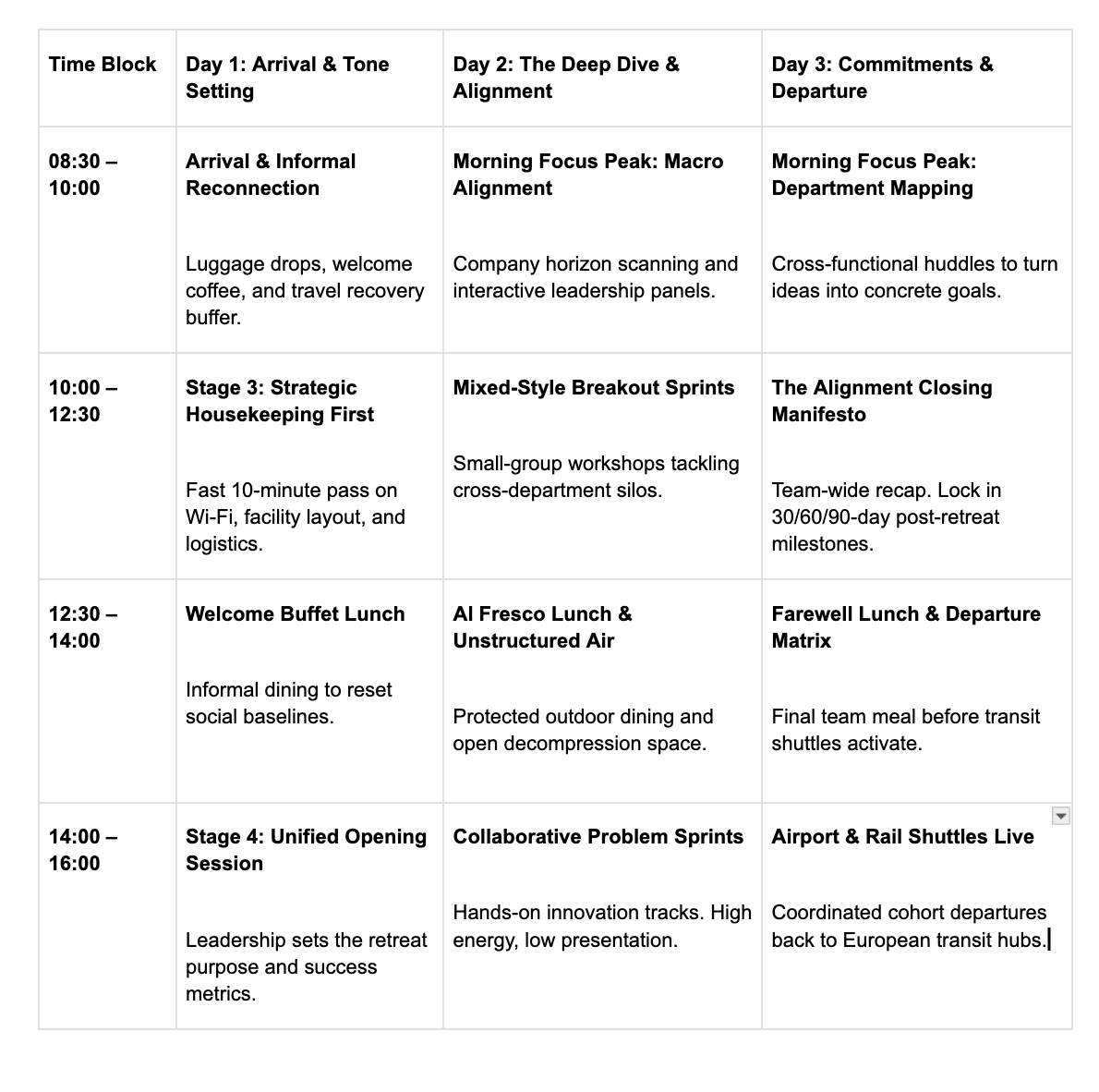
3. Sample 3-Day Corporate Retreat Agenda Template
This day-by-day framework balances strategic output with true cultural recovery. It is built explicitly for modern cross-border teams.
4. Best Corporate Retreat Ideas for Hybrid and Remote Teams
For digital-first organizations, a physical retreat is a rare bridge from isolation to collaboration. To build genuine psychological safety, ignore the trust-falls and go straight into:
The "User Manual" Hackathon: Have team members create and share a 5-point personal guide titled "How to Best Work with Me." This fast-tracks deep relational empathy far quicker than months of asynchronous Slack messages.
Cross-Functional Co-Creation Masterclasses: Pair up teams that traditionally experience friction (e.g., Engineering and Product, or Sales and Customer Success) in low-stakes, highly collaborative settings like culinary challenges or regional orientation races.
The "Un-Conference" Track: Dedicate a 2-hour afternoon slot where any team member can pitch and host a lightning session on a topic they are passionate about—professional or personal. This flattens company hierarchies instantly.
5. Should You Hire an External Facilitator for Your Offsite?
One of the biggest decisions when designing your agenda is deciding who actually leads the workshops. Many companies default to having their CEO, Head of People, or a department lead run every session. While this saves money upfront, it often limits how effective the session can be.
Here is how to know whether you can handle facilitation internally or if bringing in an external professional is worth the investment:
a. When You Can Easily DIY (Internal Facilitation)
The Session Goal is Informational: If a session is focused on presenting completed strategy updates, quarterly reviews, or educational presentations, an internal leader is ideal.
The Topic is Low-Stakes: Routine planning, simple team updates, or light creative hackathons don't require an outside mediator.
The Team Dynamics are Smooth: If there are no underlying tensions between departments and everyone feels comfortable speaking up, internal facilitation works great.
You Need Leadership Fully Engaged: When a CEO or Founder runs a workshop, they spend all their energy managing the room, reading slides, and watching the clock. An external facilitator frees up your executives so they can participate as equals alongside their team.
You Are Tackling High-Stakes or Sensitive Topics: If you are navigating a major strategic pivot, addressing cross-department friction, or running a post-merger integration, an objective third party creates psychological safety. Employees often share honest feedback with a neutral facilitator that they would hesitate to say directly to their manager.
You Want Equal Participation: Leaders naturally tend to dominate discussions. A professional facilitator knows how to gently manage loud voices and draw out insightful contributions from introverts who might otherwise stay silent.
You Want Strong Action Items: Great facilitators don't just run discussions; they keep the conversation focused and make sure every session ends with clear owners and 30-day deadlines rather than vague ideas.
6. How Much Downtime Should a Team Retreat Have?
The definitive answer is 30% to 40% of the active daytime schedule. Internal organizers often worry that unfilled slots look like a poor use of the company budget. In reality, forcing constant engagement triggers social burnout and prompts people to sneak back to their rooms to check emails.
Protecting explicit blocks of "white space" before dinner gives introverts space to reset, allows parents to call home without missing events, and provides natural space for the most valuable, spontaneous business ideas to form completely unprompted.
Inclusion, Culture & Wellbeing
1. How to Design an Inclusive Company Retreat?
True inclusion on a retreat means creating an environment where bonding doesn't rely on alcohol or physical competition. By planning thoughtful, non-drinking activities, protecting quiet time, and establishing clear behavioral guidelines, you ensure every team member, including introverts and remote employees, feels safe, valued, and welcome.
2. What are Fun, Non-Drinking Team Activities That Don't Feel Cringe?
For a long time, the corporate world relied on "open bars" as the default way to get people talking. But when your schedule revolves entirely around drinking, you end up isolating team members who don’t drink for religious, health, or personal reasons.
Instead of an open bar or awkward corporate icebreaker, try these four engaging connection ideas:
Collaborative Cooking Classes: Food is a universal language. Working with local chefs to cook regional specialties (like pasta-making in Italy or tapas-crafting in Spain) naturally splits people into small, cooperative groups where they can chat easily while working with their hands.
Guided Town Walks & Scavenger Hunts: Explore your destination with a local guide. You can set up a low-pressure scavenger hunt through historic European towns or beautiful countryside, letting teams solve light puzzles together at their own comfortable physical pace.
Creative Building Challenges: Task small, mixed-department teams with a fun, hands-on building project (such as crafting a wooden boat to race or painting a joint mural for the home office). This levels the playing field; senior leaders and new hires work side by side.
Local Craft Workshops: Tap into your venue's local culture. Whether it is a pottery class in Portugal, a woodcarving session in the Alps, or coffee-roasting in Amsterdam, learning a new skill together breaks the ice instantly.
3. How to Design a Company Retreat for Introverts
For introverts, the prospect of spending 72 consecutive hours in a crowd of colleagues can feel incredibly draining. If they do not get time to recharge, they will quickly burn out and withdraw.
To make your retreat introvert-friendly, apply these three simple design principles:
The "Quiet Room" Rule: Designate at least one room at the venue as a "No-Talking Zone." This is a safe space where anyone can sit, read, check emails, or recharge their social battery in complete silence without having to explain why.
No "Surprise" Public Speaking: Share your workshop schedules and discussion prompts in advance. Introverts process information deeply and do their best work when they have time to think about their answers beforehand, rather than being put on the spot.
Strictly Optional Evenings: Make late-night mixers and social events truly optional. State clearly from day one: "If you need to skip the evening social to rest, we support you." No guilt, no penalty.
4. Should I have a Code of Conduct & HR Policy for the Retreat?
Yes. To protect your team and set clear expectations, share a simple, friendly behavioral guide before departure. You can copy, paste, and adapt this framework for your own team:
5. Our Team Retreat Code of Conduct
a. Work Hard, Recharge Harder
We are here to connect and align, but your well-being is our top priority. We respect everyone’s right to disconnect. When the laptops close at 4:00 PM, you are officially in charge of your own time.
b. The "Choose Your Own Adventure" Policy
All social activities, dinners, and evening events are completely opt-in. We want you to participate, but if you need to head to bed early or take a quiet walk alone to recharge, your team completely supports that.
c. Safe Spaces & Mutual Respect
We expect the same level of professional respect on our retreat as we do in the office. Please be mindful of diverse perspectives, physical boundaries, and personal comfort levels.
d. Responsible Socializing
While we will enjoy great local food and hospitality, please keep consumption responsible. High-quality, non-alcoholic alternatives will always be provided at every single meal and event.
e. Photo & Media Consent
We will be capturing photos and videos to document our memories. If you prefer not to be featured in external marketing or social media posts, please let our organizing team know as soon as possible.
Sustainability & CSR
Planning a sustainable retreat means prioritizing a "reduction-first" strategy, such as choosing train-accessible venues and sourcing local, seasonal food. While a completely carbon-free event is rarely possible when teams travel, making intentional choices about where you go and how you give back to local communities makes a massive difference.
1. Carbon-Neutral Company Offsites: Is It Actually Possible?
Let’s be completely honest: if your team is flying from different parts of Europe to gather in one place, your event will generate carbon emissions. Buying cheap carbon offsets online doesn’t magically erase that impact.
At Campfire, we advocate for a reduction-first approach. This means making smart, practical choices to lower your footprint before you think about offsetting the rest:
The 70% Rail Rule: Choose destinations where at least 70% of your team can travel by high-speed rail (such as Eurostar or local European train networks) rather than short-haul flights.
Eco-Certified Venues: Prioritize hotels and retreat spaces that carry recognized European eco-labels (which prove they use renewable energy, minimize food waste, and ban single-use plastics).
Zero-Kilometer Dining: Work with venues that source their food from local farms within a small radius. Moving away from imported ingredients dramatically reduces transport emissions.
2. What CSR Activities can you Include in Your Program?
Corporate Social Responsibility (CSR) shouldn't feel like a boring lecture. It should be a hands-on, rewarding experience where your team can bond while supporting local communities. Here are 8 brilliant, highly accessible CSR activities you can build into your afternoon program:
Reforestation & Tree Planting: Partner with local European forestry groups to spend an afternoon planting native trees. It is a fantastic, physical way to leave a lasting positive mark on your destination.
Beach & Trail Cleanups: If you are staying on the Portuguese coast or in the Alps, organize a cleanup. Equipped with biodegradable bags, teams compete to collect the most litter while exploring beautiful local landscapes.
Community Kitchen Volunteering: Spend an afternoon prep-cooking or sorting surplus ingredients with local food banks and rescue charities in cities like Amsterdam, Lisbon, or Munich.
Upcycling & Building Workshops: Work with local social enterprises to build wooden items—like birdhouses, community garden planters, or benches—that are donated directly to nearby schools or parks.
Local Wildlife Habitat Restoration: Help build shelters or clear invasive plant species in protected local nature reserves under the guidance of park rangers.
Bicycle Assembly for Charity: Teams work together to assemble brand-new bicycles. Once complete, the bikes are immediately donated to local children’s charities or community centers.
Sourcing from Social Enterprises: Partner with local bakeries, craft breweries, or soap makers that employ and support vulnerable local groups to provide your retreat gifts and snacks.
Traditional Craft Preservation: Take a workshop led by local artisans (such as traditional weavers, stone carvers, or potters), keeping local heritage alive and supporting their micro-businesses directly.
3. What are Eco-Friendly Corporate Retreat Venues in Europe
When you want your venue to match your environmental values, look for properties that prioritize nature-first operations. Here are a few great examples of what to look for:
Mountain Eco-Lodges: These venues are often built entirely from sustainably sourced local wood, heated with geothermal energy, and use natural mountain water systems.
Restored Countryside Farms: Many historic farms have been converted into modern retreat spaces that operate entirely on solar power and feature organic, farm-to-table vegetable gardens.
Certified Green Hotels: Many premium city-edge properties now hold the strict "Green Key" certification, meaning they use state-of-the-art water-saving technologies, waste management systems, and organic linens.
Many teams view hiring a photographer or videographer as a nice luxury, but it is actually a massive marketing and recruitment asset. This section shows planners how to capture the weekend perfectly without making their team feel like they are constantly on camera.
Media & Storytelling
1. How to Get the Most Out of Your Retreat Media?
Capturing your retreat on camera preserves the cultural momentum long after you return. By using a clear "candid-first" photo brief and respecting employee privacy, you create a powerful media library that boosts internal morale, upgrades your social media presence, and supercharges your talent recruitment pipeline.
2. Why Documenting Your Corporate Retreat Matters
The budget spent on a retreat shouldn't just benefit the people who attended during those three days. High-quality media transforms a temporary event into a permanent business asset:
For Recruitment & Hiring: Top talent wants to see who they will be working with. Real, unposed photos of your team collaborating in beautiful locations say more about your company culture than any corporate handbook ever could.
For Internal Morale: Sharing a beautiful highlight video a month after the event acts as a powerful psychological anchor, instantly reminding the team of the trust and alignment they built.
For Remote Onboarding: When new hires join your company remotely, walking them through a visual gallery of your last retreat helps them feel connected to the team's personality right away.
3. How to Brief a Photographer for a Company Retreat
The biggest mistake internal organizers make is letting a photographer shoot a retreat like a traditional wedding or a stiff networking event. You do not want dozens of photos of people staring at a lens or holding drinks.
Give your media team a simple, friendly brief built around these three rules:
The "Fly on the Wall" Rule: Request 80% candid shots, and only 20% posed shots. Tell them to capture the active energy—the laughter between sessions, the quiet breakthroughs during workshops, and the natural conversations during outdoor walks.
Capture the Focus, Not Just the Fun: Make sure they capture your team working hard during the morning focus peaks. Photos of intense collaboration and brain-heavy problem-solving are what prove the business value of your offsite to stakeholders.
The Golden Hour Group Shot: Plan one, and only one, big, casual group photo. The best time to do this is right after the 4:00 PM Pivot on Day 2, when laptops are closed, the natural lighting is soft, and everyone is relaxed.
4. Social Media Repurposing Ideas After Your Retreat
Once you have your media folder back from the production team, don’t just leave it sitting in a cloud drive. Use these 5 simple ideas to share the story of your retreat across your external channels:
The "Behind the Scenes" LinkedIn Carousel: Share a gallery of 5–6 candid photos showing your team mapping out future goals. Write an honest caption about the top three strategic insights your team unlocked during the workshops.
The Day-by-Day Instagram Reel: Edit a fast-paced, 60-second video tracking the transition from your opening session and your outdoor activities. Keep it light, fun, and authentic.
The "Day in the Life" Employee Takeover: Have an employee document their personal retreat journey on your company’s social stories, from traveling to the venue to hanging out at the farewell dinner.
The Culture Update on Your Careers Page: Swap out old, outdated office headshots on your recruitment portal for fresh, high-energy photos of your team working together at your retreat venue.
The Internal "Blooper Reel": Create a lighthearted, internal-only video compilation of funny, candid moments and outtakes to share on Slack. It is an amazing way to keep the team smiling for weeks after they return home.
Follow-Up & Feedback
1. How to Measure Success & Keeping the Momentum?
The true value of a retreat is realized in the weeks after you get home. To protect your investment, send out an anonymous feedback survey within 48 hours of departure to capture honest reactions while the experience is fresh, and immediately schedule follow-up checkpoints to turn your retreat ideas into real, lasting habits.
2. Post-Offsite Survey Questions for Employees
Anxiety and fatigue fade quickly, but so does inspiration. If you wait more than a few days to send your post-retreat survey, your data will lose its accuracy.
Here are 15 ready-to-use survey questions. We recommend using a simple 1–5 scale (Strongly Disagree to Strongly Agree) for the quantitative questions, with a text box for written feedback under each section:
Category 1: Travel & Logistics
The pre-retreat communication and packing lists gave me all the information I needed to feel prepared.
The travel arrangements (flights, trains, and venue transfers) were smooth and easy to navigate.
The venue (bedrooms, meeting spaces, and food options) was comfortable and met my expectations.
The balance between scheduled events and unstructured downtime felt right.
Category 2: Content & Alignment
The morning strategy and alignment sessions were engaging and a good use of our time.
I feel clearer about the company’s goals and our direction for the next 6 to 12 months.
The workshops and group sessions gave me a better understanding of how other departments work.
I feel empowered to take action on the ideas we discussed during our team sessions.
Category 3: Culture & Connection
The team-building activities felt inclusive, comfortable, and welcoming.
I had meaningful opportunities to connect with colleagues I don’t work with on a day-to-day basis.
The retreat helped build a stronger sense of trust and community within our team.
I feel more motivated and connected to the company culture after this event.
Category 4: Open-Ended Questions
What was your absolute favorite moment or activity of the retreat, and why?
If we could change or improve one specific thing for our next retreat, what should it be?
Is there any other feedback you would like to share with the planning team?
3. How to Maintain Momentum After a Company Retreat
It is incredibly common for teams to return from an offsite feeling inspired, only to get buried under an avalanche of emails and forget every commitment they made. To stop this from happening, use these three simple steps to keep the momentum alive:
The 48-Hour Recap: Within two days of returning, send a short "thank you" email to the entire team. Include a link to a shared folder of raw photos, the anonymous feedback survey, and a brief, high-level summary of the main decisions made.
The 30-Day Commitment Board: Don't let workshop notes sit in a forgotten document. Create a simple, public tracking board (on Trello, Notion, or Monday.com) with the key projects born at the retreat. Assign a clear owner and a 30-day milestone to each one.
The "Retreat Reunion" Coffee: Three to four weeks post-event, host a voluntary, casual 30-minute virtual call. Share a 2-minute highlight video of the retreat, announce the top-line results from the feedback survey, and celebrate the first round of completed 30-day milestones.
Ready to Bring Your Team Together?
Planning a corporate retreat that actually works doesn't happen by accident. It requires a clear business goal, a schedule that respects human energy, and airtight logistics that keep unexpected costs at bay.
When you get it right, an offsite isn't an expense—it is an investment that lowers stress, boosts trust, improves collaboration, and leaves your team completely aligned for the months ahead.
Want to skip the 100+ hours of planning stress?
At Campfire, we handle everything from finding the perfect European venue and auditing tricky contracts to organizing inclusive activities and managing on-site logistics. Whether you are a team of 20 or 1500+, we build retreats that match your budget and elevate your culture.






%20(1).jpeg)


