Home
>
Blog
>
Trends and insights
>
Team Retreats and CO2: A Deep Dive into Carbon Footprints, ESG, and Low‑Carbon Offsites
Corporate retreats are the way to go to elevate your team. But it can also elevate much less desirable things, such as your CO2 emissions.
In a net-zero context, achieving a balance in which the greenhouse gases (GHGs) we put into the atmosphere are equal to those we take out, team retreats do have a role to play. Business travel and events are an essential part of Scope 3 emissions, all the indirect greenhouse gas emissions from your company's value chain that you don't directly control (suppliers, transport, waste...). Companies now find themselves under pressure to demonstrate concrete strategies to reduce emissions, not just offsets.
In this first deep dive of 2026, we look at where retreat emissions come from, how to measure them, how to design lower-carbon retreat, and how this links to environmental, social, and governance strategies.
When it comes to emissions, transport is always the biggest culprit in the travel and tourism industry, accounting for about 40% of total emissions.
Air travel alone represents between 2.5 and 4% (1) of global emissions (depending on whether you take into account non-CO2 emissions), and corporate travel is considered to represent 15 to 20% of that.
ESG stands for Environmental, Social, and Governance, a framework assessing a company's sustainability and ethical impact beyond financials.
In the business travel industry, ESG focuses on reducing Scope 3 emissions.
Scopes 1, 2, and 3 are the categories of the Greenhouse Gas (GHG) Protocol, which classifies a company's carbon footprint to help manage and report it.
Scope 1 emissions are direct emissions from sources a company owns or controls (like factory boilers or company vehicles). In contrast, Scope 2 emissions are indirect emissions from purchased energy (electricity, steam, heat, cooling).
Finally, scope 3 emissions refer to all indirect greenhouse gas emissions occurring in a company’s value chain, excluding those from purchased energy (that is Scope 2). This includes upstream activities, such as purchased goods, and downstream activities, such as product use.
It is interesting to note that, if the same carbon footprint falls under different scopes (Scope 1, 2, or 3) for other entities in a supply chain, depending on who is reporting it and their role in the activity, a reconciliation system will avoid double-counting the same carbon emission.
Scope 3 encompasses 15 categories of indirect emissions not owned or controlled by the company:
Category 1 – Purchased goods and services
Category 4 – Upstream transport
Category 7 – Employee commuting
Category 8 – Upstream leased assets
Category 9 – Downstream transport
Category 10 – Processing of sold products
Category 11 – Use of sold products
Category 12 – End-of-life of sold products
Category 13 – Downstream leased assets
Often, those accounts for the largest share of total emissions (up to 90% for some firms).
In the business travel and team retreat industry, Scope 3 Category 6 covers emissions from employee transportation in third-party vehicles, primarily air travel (the largest contributor as we saw above), rail, buses, rental cars, taxis, and, optionally, hotel stays during trips. The vehicle used must not be owned or operated by the company. Category 6 also includes business stays in hotels and venues.
The hospitality and events industry is actively setting ambitious decarbonization targets through initiatives such as the Sustainable Hospitality Alliance and the Net Zero Carbon Events roadmaps.
The Sustainable Hospitality Alliance's Global Hotel Decarbonisation Report targets a 66% absolute emissions cut by 2030 and 90% by 2050 from 2010 levels, focusing on energy efficiency, renewables, and electrification to meet Paris Agreement limits.
The UK Hospitality's Net Zero Roadmap aims for zero avoidable Scope 1/2 emissions by 2030 and full Scope 3 by 2040, and provides tools such as sustainability guides for venues.
Concerning events, Net Zero Carbon Events provides practical roadmaps for conference and retreat organizers, promoting low-emission travel, waste reduction, and supplier audits, directly applicable to corporate offsites.
HOTREC's Net Zero Hospitality Roadmap unites European stakeholders to achieve 55% cuts by 2030 and net zero by 2050, emphasizing transport decarbonization and food sustainability.
These are just a handful of the initiatives and show how much travel industry professionals, including venues and companies doing retreats, are “pressured” to decarbonise. For HR, Head of People, or whoever is in charge of organizing the company’s retreats, these targets mean rethinking how to plan off-sites already today.
Let’s break down a typical retreat to understand the different emission sources better:
All journeys to, from, and during the retreat (flights, rail, car, transfers).
Travel to and from the retreat is usually the primary source of emissions, especially when people fly. Studies and industry guidance for events show attendee transport can account for around 80–85% of an event’s total carbon emissions, particularly when long‑distance travel or flights are involved. And of course, the mode of transport you chose matters.

The global hotel sector is responsible for roughly 1% of global CO2 emissions. For a retreat, this translates into energy use per guest‑night (heating/cooling, lighting, hot water, laundry) plus any on‑site fuel like gas or diesel.
KPI Depot proposes a benchmark for the amount of energy used by a hotel per guest staying overnight.
Above 20 kWh per guest night – Indicates significant inefficiencies.
15-20 kWh per guest night – Watch zone.
Below 15 kWh per guest night – Healthy benchmark.
Regarding CO2 emissions, different sources (ADEME, HCMI, DEFRA) indicate that 3-4-star hotels typically emit between 8 and 12 kg of CO2 per guest/night.
These can be good questions to ask your venue: What is your kWh per guest-night? Do you follow any Net Zero roadmap?
What people eat and drink, how it is produced, transported, and wasted. Food systems globally are responsible for roughly a quarter of greenhouse gas emissions, with travel‑related contexts adding extra packaging, refrigeration, and energy for cooking. Food waste alone accounts for about 8% of global emissions (about 5 times more than aviation!). It is a known hotspot in tourism and retreat settings, known for buffets and oversized portions.
Looking at the graph below, when it comes to corporate events, travel, while still significant (above 30%), is not the biggest contributor to the carbon footprint; food is with over 40%.


Production choices and “extras” around the programme form a smaller but still material part of a retreat’s footprint. Purchased goods and services, such as AV equipment, stage sets, branded merchandise, printed workbooks, and activity equipment, fall under Scope 3 categories. Digital elements (streaming, virtual participation, cloud tools) have a footprint too, but for most retreats, this is minor compared with flights and buildings, unless the digital audience scales very large.
At Cop26 in Glasgow (2021), the Net Zero Carbon Event Pledge was launched. It encourages all companies in the event industry to join, whether they are operators (event venues or organizers), supporting associations, or partners (clients, suppliers, destinations…). The initiative aims to bring together industry stakeholders to:
To that aim, they have developed a roadmap with templates for reporting and calculating emissions. Online calculators also exist. But before you jump into calculation mode, you need to understand who is responsible for reporting what.
It may seem a bit daunting at first, so we are breaking it down for you here.
Who is in charge of this topic within the company? In large companies, there will be a Director of Sustainability / Head of ESG or even a carbon accountant whose role is dedicated to these questions. In smaller businesses, however, the responsibility often falls on the owner, an operations manager, or a finance/admin lead, who work together with colleagues and departments to gather the information.
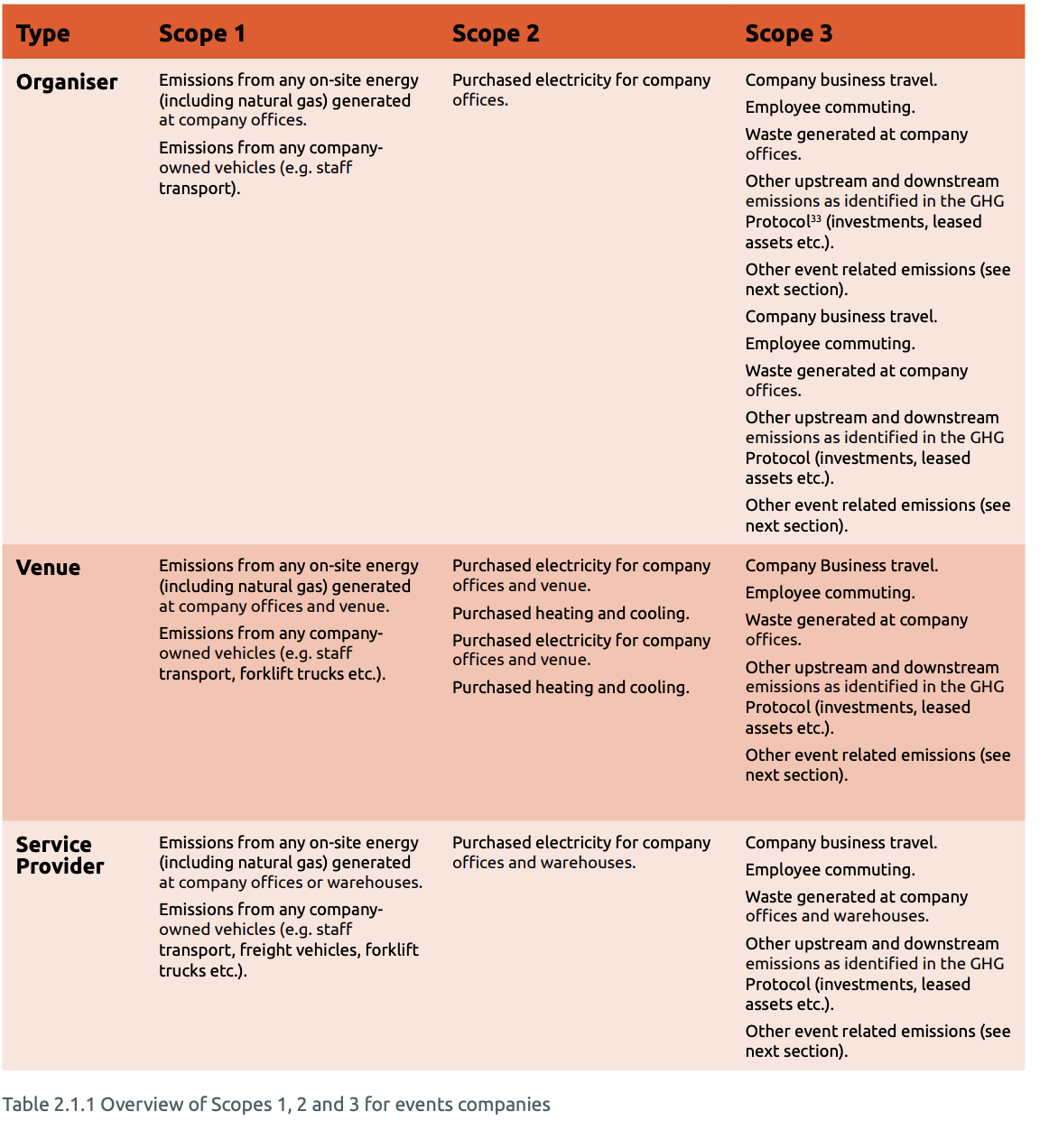
In the table above, the organizer is the company sending its employees on the retreat. It is the company that carries most of the “reporting burden”.
If a third party supplier (event organizer) is involved and reporting, they would report their scope 3 emissions mostly under category 9, suppliers they manage under category 1, their own operations (venue energy, their staff travel) under Scope 1 and 2, and only if they book the trips themselves for the clients, that would go under scope 3 - 6.

In practice, there are quite a few different data to collect:

There are three methods to calculate scope 3 emissions from business travel, depending on the data you have available:
An emission factor is the average amount of greenhouse gas emitted per unit of fuel burned for a specific fuel type and, sometimes, vehicle/engine type (e.g., kg CO2e per litre of diesel or petrol).
For example, let’s say your team of 5 took the train from Paris to Milan.
The distance is about 900km.
For passenger trains, the emission factor is about 0.035kg CO2 per passenger per km.
900 x 0.035 = 31.5 kg Co2 emission for 1 person. For a round trip for a team of 5, that means 1800 x 0.035 = 63
63x5 = 315 kg Co2 emission / team.
This result lets you attribute a portion of your organisation’s carbon footprint to that specific business trip.
There are primary emission factors built from primary data, meaning they are calculated using direct, supplier‑ or facility‑specific information, and secondary emission factors coming from generic databases or averages, and are used when primary, product‑specific data is unavailable.
Before diving into the calculations, take a moment to reflect on your current habits and identify what can be avoided, reduced, or offset.
A fundamental question worth asking is: Do we really need this trip? Could objectives be bundled into fewer, better‑designed offsites? Team retreats are what we do, but our KPIs are for meaningful, successful offsites, not just “number of retreats/year.” We are facilitators at heart, and what matters is well-designed corporate retreats that bring people together, engage teammates, and produce long-term ROI, not monthly getaways for the fun of it.
Whether you are planning everything yourself or using a third party, keep in mind when looking for your next destination: the distance traveled, the mode of transport, and how sustainable the venues and suppliers are. Prioritise venues with clear climate targets, renewable energy, efficiency measures, and waste-reduction policies. Similarly, try to work with caterers with lower‑impact menus (more plant‑rich, seasonal, local…).
Offsetting should be the last option for residual emissions to avoid the risk of greenwashing.
In case of offsetting, you want to use high-quality credits (certified) and be transparent about what you are and are not doing. A good framework to use is the Oxford Principles for Net Zero Aligned Carbon Offsetting.
Of course, as a business, some emissions cannot be avoided; those are the only ones you will want to offset.
Keep in mind that offsets are an extra layer, not a way to hide emissions; they are reported separately and not subtracted from your emission inventory.
Keep it clear and honest. It is always better to say “We emitted X tonnes CO2e in 2025, reduced by Y% vs 2024, and purchased high‑quality credits for the remaining Z tonnes” than using vague claims like “carbon neutral” or “climate positive” that don't really give any information.
In this section, we have created a template for your company's internal Environmental, Social, and Governance practices for employee communications. It is a starting point that can be improved and made much more detailed if you wish to go more granular with your data.
Make sure to make a copy of it before you edit anything.
Retreat Emissions Template – DO NOT EDIT STRUCTURE
Corporate retreats don't need to be carbon liabilities. They can become demonstrable wins in your ESG strategy. With a large share of emissions controllable through smarter travel choices, venue selection, and digital substitution, every retreat becomes a chance to deliver both team cohesion and climate progress.
And it does not need to be overwhelming. Here are three immediate actions you can take:
The data shows low-carbon retreats aren't just possible, they're a competitive advantage. Forward-thinking HR leaders are already benchmarking suppliers on Scope 3 Category 6 performance. Your next retreat can set the standard. Start calculating today!
From practical insider warnings to new secret locations, get our monthly, genuinely spam-free newsletter.
Subscribe now
%20(4).jpeg)