Home
>
Blog
>
Trends and insights
>
Structural Wellbeing: Why 2026 is the Year We Stop Fixing People and Start Fixing Work
Jamie has been with a startup for about two years as a marketing manager. She manages the company’s social media, writes the weekly blog articles and website content updates, and creates the monthly newsletters. The business is growing, numbers are in the green and on paper, the team has everything it needs: a gym card paid by the company, a constantly overflowing fruit basket, weekly afterworks, Friday breakfast, a ping pong and foosball table in the office, and even a mental health app giving access to free meditation courses and even book consultations with psychologists. They have all the perks. And yet, Jamie knows that she and most of her coworkers are slowly burning out.
The wellness budget might be generous, but in reality, with constant deadlines and a small, still-growing team, there simply is no time to use any of these perks.
Jamie might be a fictional character, but we all know one, don't we? We might be Jamie ourselves.
So here is the big question of our third deep dive: If burnout is a boardroom-level risk in 2026, why are we still trying to fix it with yoga apps instead of redesigning the work itself?
In 2026, it is time to understand that burnout is now a structural business risk (operational, financial, reputational), and not just an individual resilience issue. Wellbeing is no longer the sole responsibility of the individual; it is now an integrated part of the fabric of a modern workplace.
In this piece, we aim to provide a practical lens and a roadmap for heads of people, HR, heads of culture, and founders and COOs facing wellbeing challenges in their teams.
In 2026, mental health and burnout have definitely moved from a “side note” to the top of the company's risk list, alongside cyber, climate, and geopolitical risks. Workforce burnout belongs in the same risk conversation as cyber and climate risks, because it directly affects your ability to respond to other challenges. Burnout is not a wellness issue; it is a risk multiplier for every item already on your board agenda.
In the UK, the CIPD, the Chartered Institute of Personnel and Development, an association for human resource management professionals, publishes annual reports on mental health and wellbeing at work.
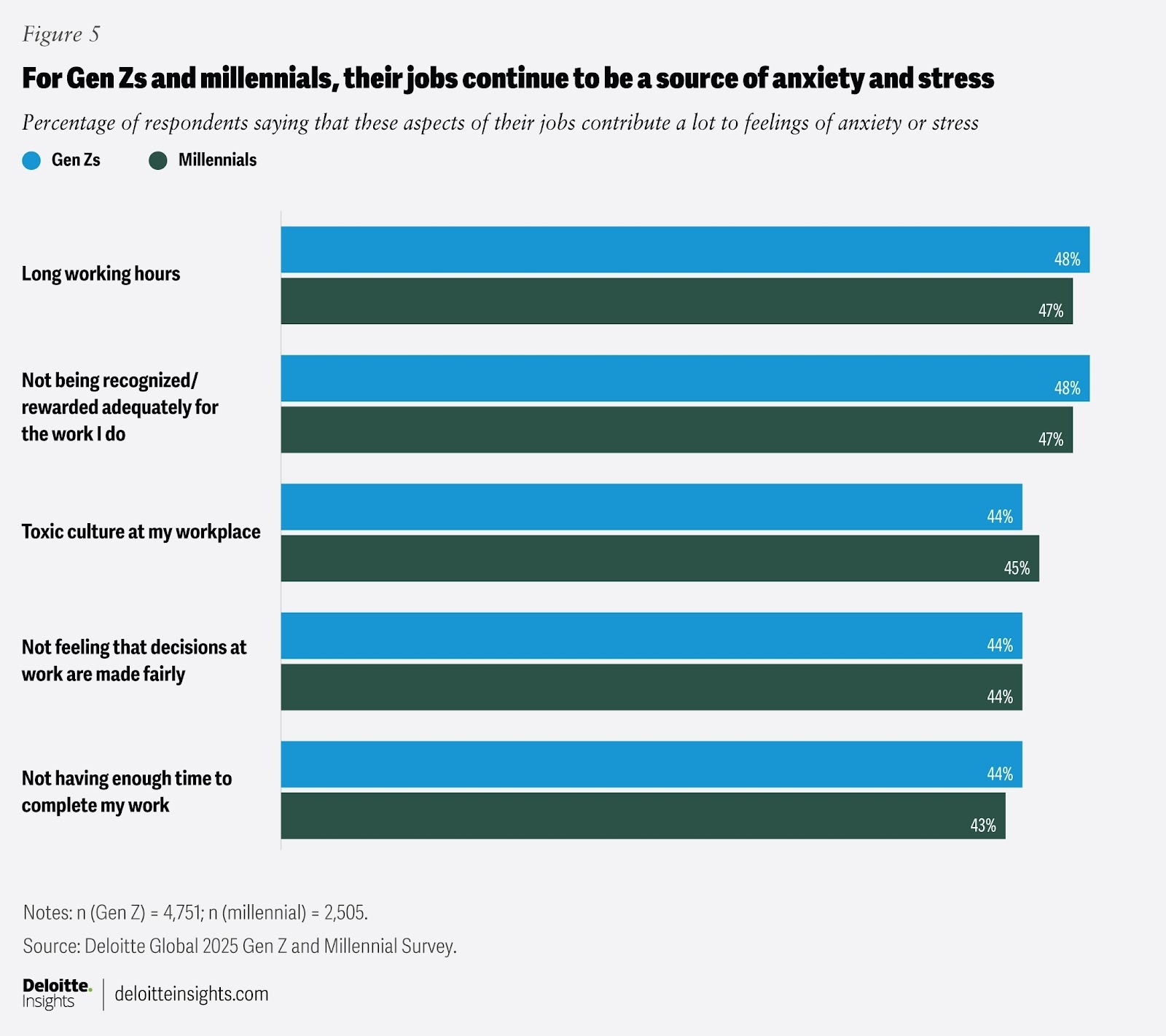
Similarly, a study by Deloitte specifically on the generations that make up most of the workforce today (Gen Z and Millennials) shows that long working hours, lack of recognition, and toxic work culture are the top three sources of stress and anxiety.
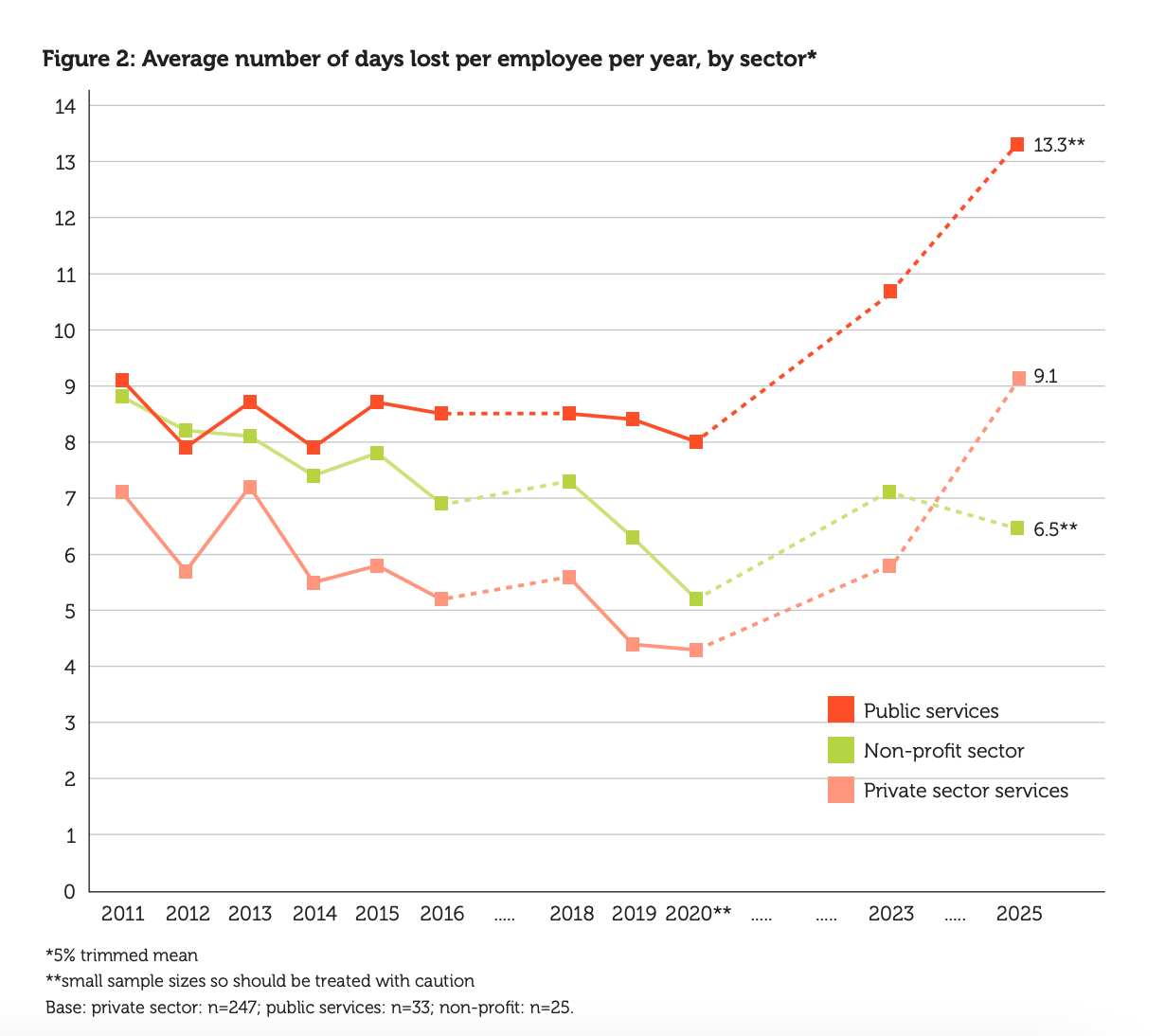
🇬🇧According to the CIPD, the average number of absence days per employee per year in the UK has risen to 9.4 days, the highest in more than 15 years. The average number of days lost per employee per year varies by sector, as shown below. Only the non-profit sector has seen a decrease, while both the private and public sectors have seen a significant increase since 2023.
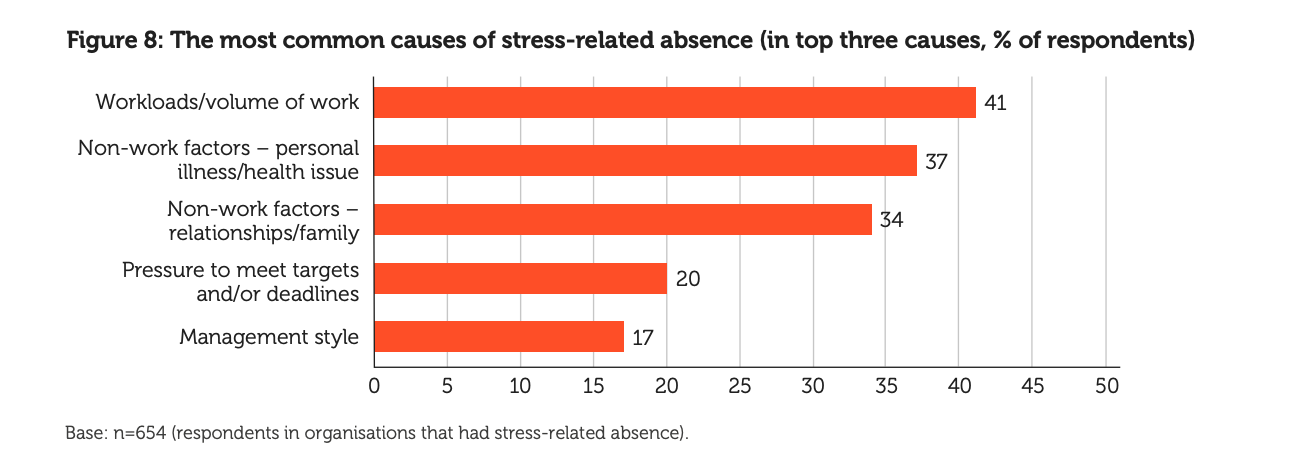
Interestingly, the report shows that while minor illness remains the most common cause of short-term absence, psychological health, encompassing poor mental health and stress, is the second main cause of short-term absence and the main cause of long-term absence (4 weeks or more). But it is not just the UK; all over Europe, absenteeism and mental health issues seem to increase “hand in hand”.
🇫🇷 France has seen absenteeism increase by 41% over 5 years, according to the latest AXA report, with a 17% increase in the average length of absence. The culprit? Mental illnesses are at the top, with burnout highlighted: a 15% increase between 2023 and 2024 and a 66% increase since 2019.
🇩🇪 In Germany now, according to one of the largest insurance companies in the country, AOK (Allgemeine Ortskrankenkasse), in 2024, the rate of employee sick leave had reached a historically high level. While mental health issues were not the main reason for absenteeism, they had been rising steadily over the past 10 years by 43%.
🇪🇸 When it comes to Spain, a 2024 report from Umivale Activa and the Valencian Institute of Economic Research showed that the number of working days lost to sickness in 2024 had increased 6.6% since 2023. The second main cause is mental health issues.
In February 2025, LHH, a talent solutions provider within the Adecco Group, published a survey across 10 countries that showed the prevalence of executive stress and leadership shifts. According to the data, leadership burnout has reached 56%, with Millennials and Gen Z particularly affected, resulting in over 43% of organizations experiencing leadership turnover in 2024. This is particularly impacting the sales, media, and marketing sector, where turnover can reach 50%.
Of course, with increased absenteeism and turnover, companies spend more time trying to replace employees or increase workload for those who remain, creating a vicious circle that breeds more disengagement, stress, and burnout.
Burnout slowly destroys motivation and teamwork, reducing creativity, collaboration, and problem-solving capacity, ultimately bringing the whole team down.
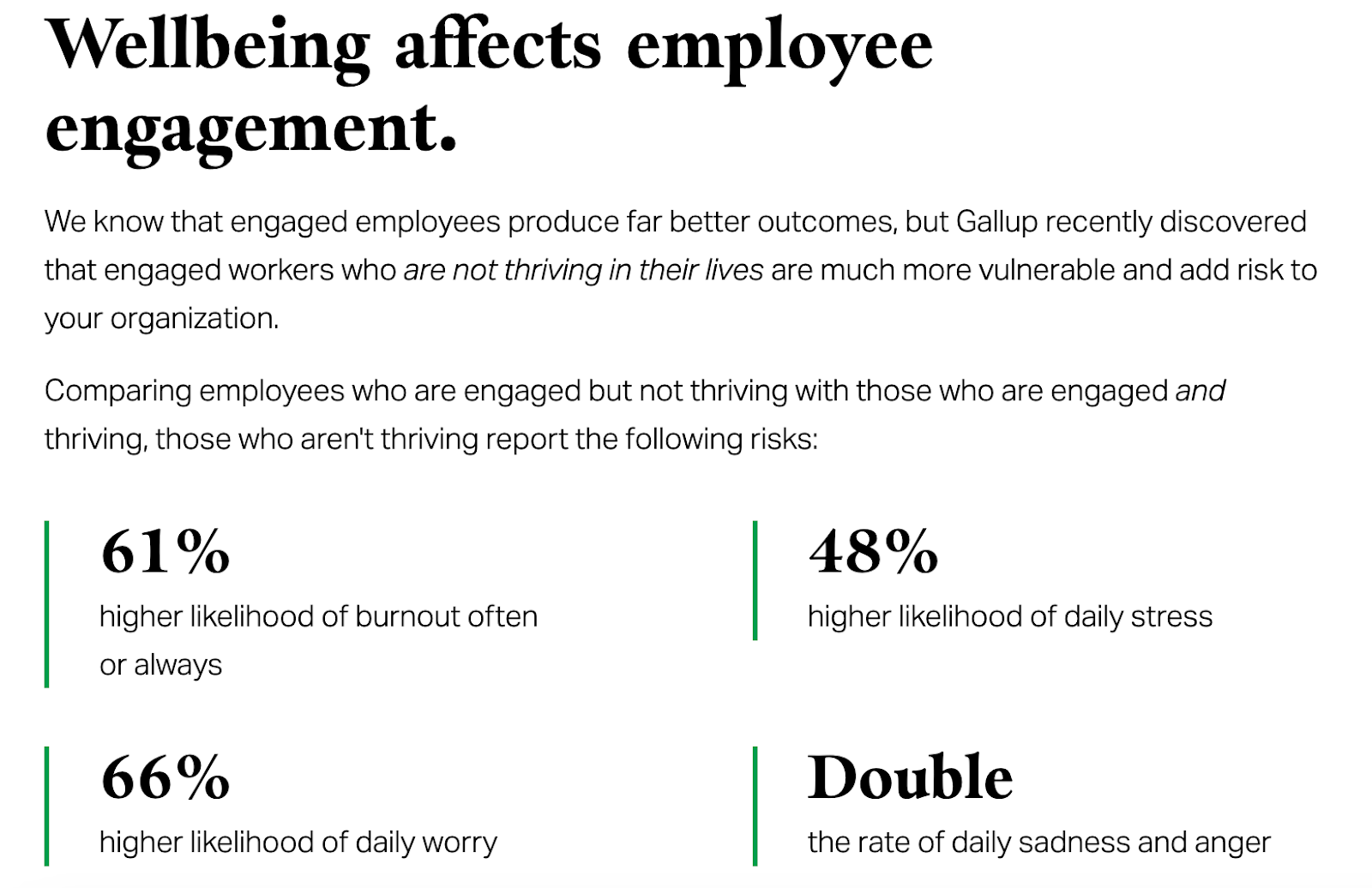
And all of that has a cost for the businesses, beyond the human “cost” and the wellbeing of the individuals. According to Gallup, the costs of turnover and lost productivity exceed $300 billion globally.
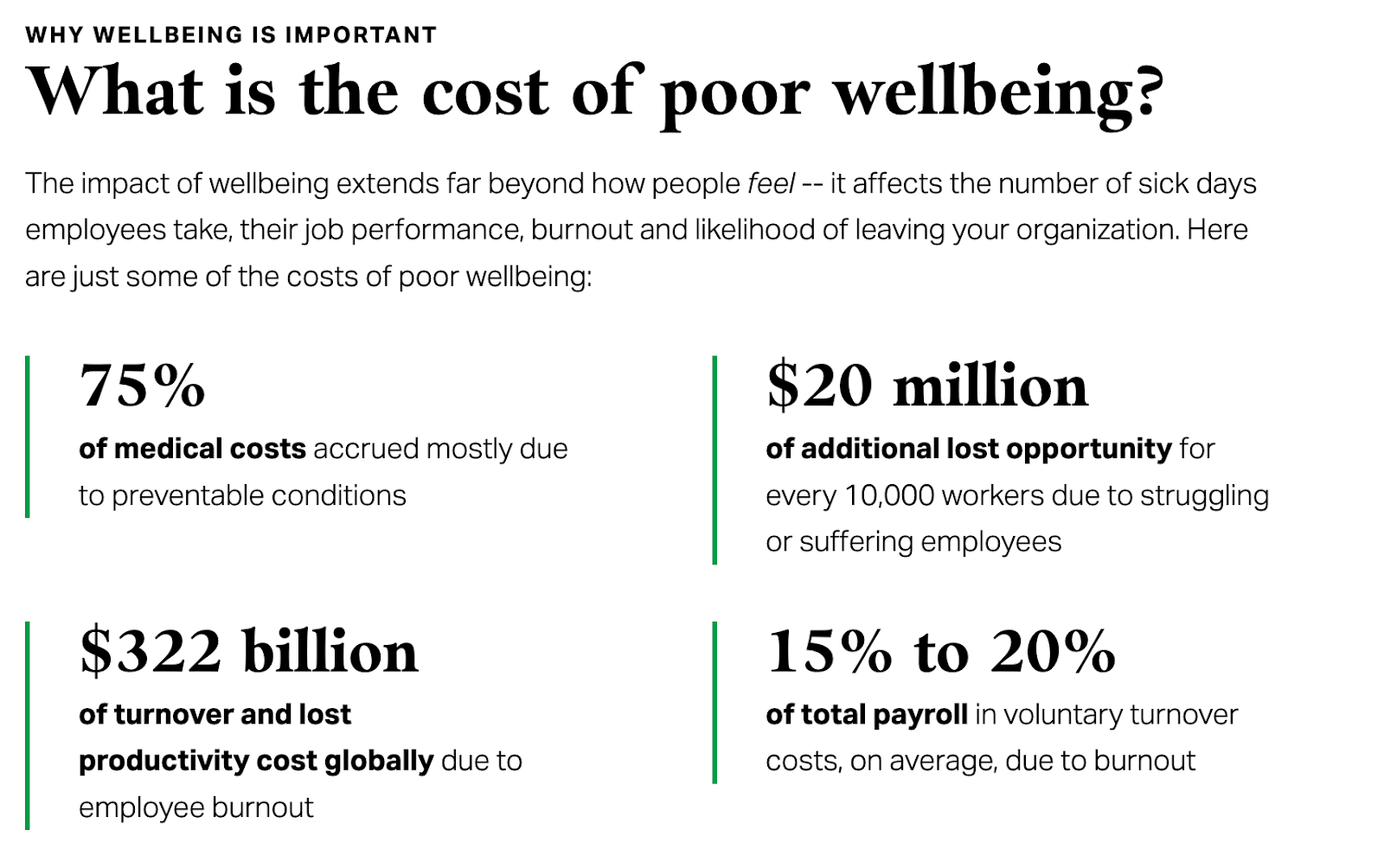
Deloitte’s report on Investing in Mental Health in the UK presented £42 billion of losses due to absenteeism (£7 billion), turnover (£9 billion), and presenteeism (£28 billion) created by mental health issues, especially in industries like finance, insurance, real estate, and communication.
From roughly the early 2000s to quite recently, workplace wellbeing has predominantly rhymed with perks: subsidised meditation apps, weekly yoga or mindfulness workshops, “Wellness Wednesdays” with free smoothies or kombucha taps, and in-office treats from fruit bowls to nap pods. It is tech giants like Google that seem to pave the way with unlimited snacks and playrooms. Others followed with gym memberships, an in-house masseuse, or an in-house barista, like the now-infamous WeWork. With COVID-19 and the rise of remote and hybrid work, employee assistance programs (EAPs) have become a must-have perk.
The idea was to give employees as many tools and tricks to cope with whatever mental health issues they may have, by themselves, and focus on staying productive.
Unfortunately, as we saw above, the stress and mental health sick days have continued to increase, and the cost of absenteeism and turnover has risen.
In addition, the workplace has become so intertwined with private life that many barriers between personal and professional challenges have broken down. The rise of hybrid work of AI has brought its own share of problems with the explosion of digital channels and the feeling of having to be “always on”.
This is not to shame the regular perks. We’ve all enjoyed the fruit basket, the free latte when we’re late for a meeting, the ability to go to a yoga class without leaving the office, or to play a ping pong match at the end of a long day.
But if these can brighten our day, they are not enough to make us feel better in the long run or to address the underlying issue we face.
A 2024 study by Dr. William Fleming at Oxford University surveyed more than 45,000 workers across 233 organizations and found that those using mindfulness, sleep apps, and resilience training were not significantly better off than those who did not.
This and other research have led to the realization over the last few years that, while we’ve tried to fix people over and over by throwing things they should like at them, we’ve yet to truly try to fix the work itself.
What if what made us feel burnout wasn't the lack of free snacks but the toxic work culture? As it turns out, “work (re) design” might be the solution we’ve been looking for for so long.
Indeed, in 2022, researchers studied a six-month period in 2021 dubbed the Great Resignation and examined turnover rates relative to wages. They analyzed the impact of 170+ cultural topics on employee attrition, and, unsurprisingly, toxic culture was more than 10 times as likely to contribute to turnover as compensation.
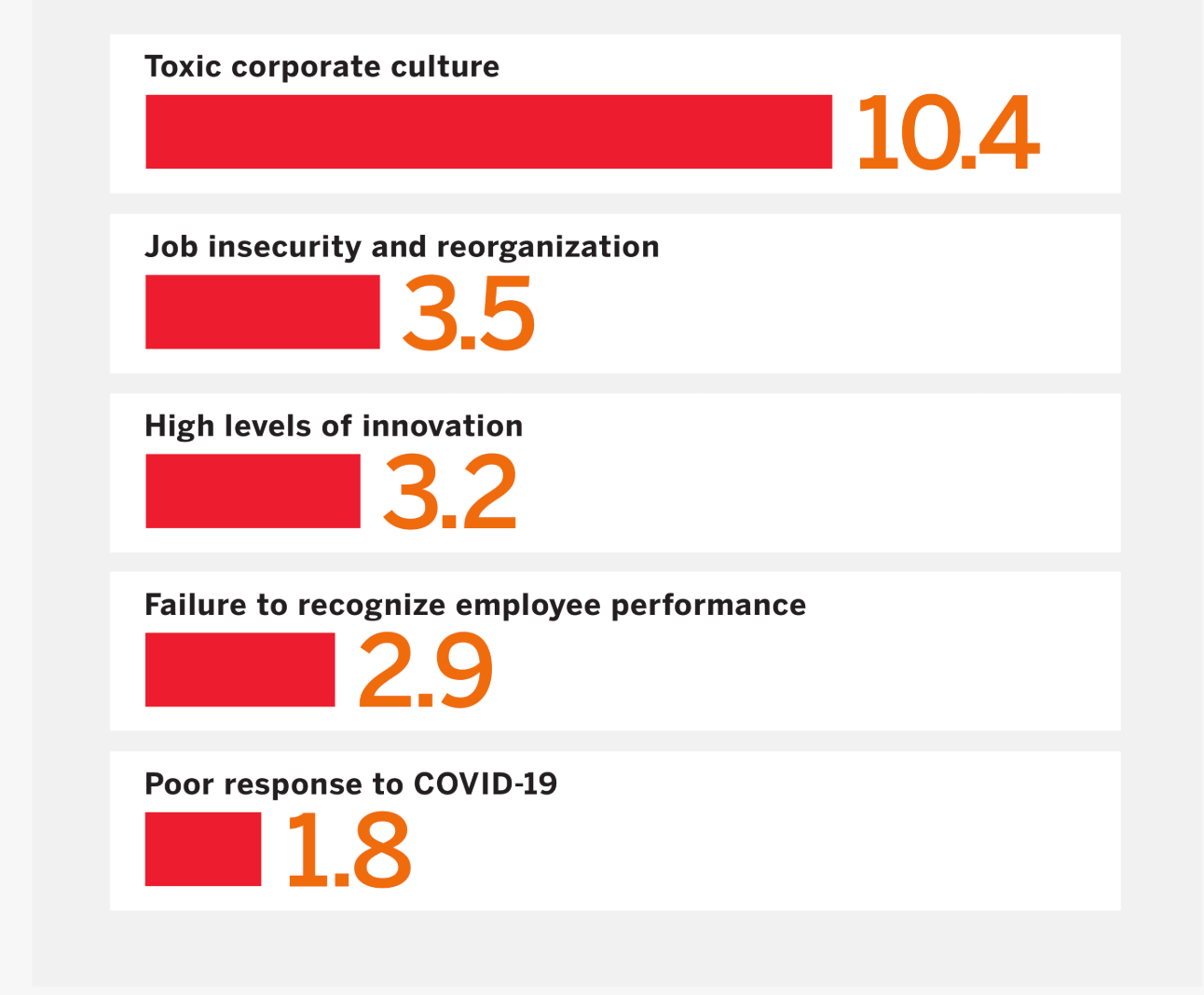
For years, researchers say, we have been treating symptoms rather than the underlying system. “We have reached the limit of what a meditation app can do for an employee working a 70-hour week under a micro-manager.”
Let’s have a look at this “resilience” we hear so much about. Resilience is the ability to mentally or emotionally cope with a crisis or to return to pre-crisis status quickly. And over the last few decades, this skill has been thrown around as the cure for all workplace problems, from tight deadlines to toxic cultures.
This is not to say that resilience is useless. It is a very useful ability that does need training and can greatly help in certain situations, but “a lack of resilience” has somehow become a scapegoat for everything wrong with the workforce. It has become the individual's responsibility to become more resilient to whatever the company asks of them.
Yet research shows that resilience alone is not enough. And at times, it's not the right way to go, especially when used to guilt-trip employees into accepting more, shifting responsibility onto the individual once again.
When we talk about resilience, we need to understand it holistically. Resilience can only work if it stands on the four pillars of team resilience.
Ensuring these 4 pillars are present in a company is the only way organizations can begin to drive lasting change at the cultural and organizational levels, rather than placing the burden on individuals alone.
Companies need to understand that improving employee wellbeing must be done at the business level as well. Just as offering “resilience training” without addressing the real issues (a 70-hour workweek?) does, offering free mental health programs and apps will only address symptoms, never the reasons employees are quietly quitting or leaving for good.
Enter, Structural Wellbeing. Structural wellbeing is the architecture of our environment that supports the health, resilience, and flourishing of all, rather than relying solely on individual responsibility. In the workspace, it encompasses HR, operations, leadership, and risk management, moving the needle from “perks” to actual processes.
To “fix work” at a structural level, organizations must transition from seeing managers as mere task-trackers to seeing them as “architects of the everyday” who actively manage workload vs. human capacity, identify peak periods, ensure role clarity, and use AI for tasks that clutter the workday, effectively reclaiming time for the “human premium”.
Most companies treat wellbeing like a bandage to apply after someone gets hurt. Structural Wellbeing is simply fixing the environment so people don’t get hurt in the first place. So let’s look at the foundations of a healthy work structure.
If an employee has 50 hours of work on a 40h contract, “mindfulness” won’t help. Management must actively match the “load” to the “capacity.” This means having a process to say “no” to new projects when the team is full, and protecting periods of rest after a big push so people can actually recover.
A significant source of workplace stress is uncertainty about what you are responsible for or who has final authority. Clear “Job Architecture” is the way to go. Every person should know: What am I responsible for? What decisions can I make alone? How is my success measured? When these are clear, the “mental tax” of the job drops instantly.
In a digital world, the default state is “available.” If an employee feels they might get a notification at 8 PM, their brain never fully enters a rest state. It is essential to have clear, company-wide communication rules. It’s not a “suggestion” to log off; it’s a structural expectation. You create “windows” for deep work and “windows” for total silence.
As it turns out, humans can handle immense stress if they feel they are part of a pack that has their back. Isolation makes work feel heavier. Creating deliberate, screen-free time for teams to actually know each other. This isn’t a “fun perk”; it’s about building the trust necessary so that, when things go wrong, the team solves the problem together rather than blaming one another.
If you want to fix these four things, you can’t just send an email about “self-care.” You have to change the actual definition of the roles, the hierarchy, and the expectations.
The era of treating employee burnout as a personal failing is over. In a marketplace where AI has commoditized technical output, your only remaining competitive advantage is the collective energy, judgment, and creativity of your people. You cannot access that “Human Premium” if your team is stuck in survival mode. We must stop asking individuals to be more resilient to broken systems and start designing systems that are worthy of their talent.
Structural wellbeing is no longer a “nice-to-have” HR initiative; it is the essential architecture of high performance. When you clarify roles, protect time, and right-size workloads, you aren’t just being “kind”; you are engineering a culture that can innovate better and outlast and outperform the competition.
Start by looking at the data you already have:
If your team is struggling, ask:
Ask managers to answer these questions honestly:
These questions aren't just a diagnostic; they are your roadmap for structural change. By moving from "fixing people" to "fixing the framework," you stop managing exhaustion and start leading a sustainable, high-performing team. If you feel like you need a break from the day to day and take some time in nature to rethink your systems, get in touch!
From practical insider warnings to new secret locations, get our monthly, genuinely spam-free newsletter.
Subscribe now


The Architecture of Psychological Safety: Why Workplace Mental Health Needs a Physical Reset
Read more


