Discover actionable insights on fostering a workplace culture that inspires and engages—trusted by over 24,000 subscribers worldwide.
Thank you! Your submission has been received!
Oops! Something went wrong while submitting the form.
For decades, many corporate retreats have failed to deliver on their promise of connection: they're often high-stakes events disguised as leisure. The intent is unity, but the reality is exhaustion. This points to a deeper issue: mandatory fun doesn't foster genuine engagement.
In 2026, as remote and hybrid work becomes the default, the “offsite” has changed. Employees no longer want a curated performance of company culture; they want to experience it authentically.
When bonding is treated as a requirement, it stops being a reward and starts being a chore. This is why forward-thinking leaders are shifting their strategy from control to curation.
Why Choice is Your Best Investment
The shift toward “opt-in” models isn’t just about being “nice”; it’s backed by the reality of human psychology and modern productivity metrics:
The Introvert Tax & Social Exhaustion:With nearly 56% of the world population prefering introversion, forced group high-energy activities definitely create a “Social Tax.” Psychological Science suggests that for introverts, forced interaction without recovery periods leads to a “rebound effect” of withdrawal, decreasing collaborative output post-event.
Psychological Reactance: People naturally resist being told how to feel. Brehm’s theory says that when freedom of choice is threatened: like being told to enjoy a scavenger hunt, people tend to react with negativity and disengage.
A successful retreat isn’t an empty schedule; it’s about providing “guided freedom”. You don’t leave people to drift; you give them different “tracks” so they can choose how they connect. If there is a three-hour “gap”, suggestion options that can fill everyone’s cup:
Collective Action: Mountain biking or shelter-building for those who bond through shared adrenaline and results.
Reflective Connection: Foraging walks, wood-whittling, or photography for those who open up while decompressing.
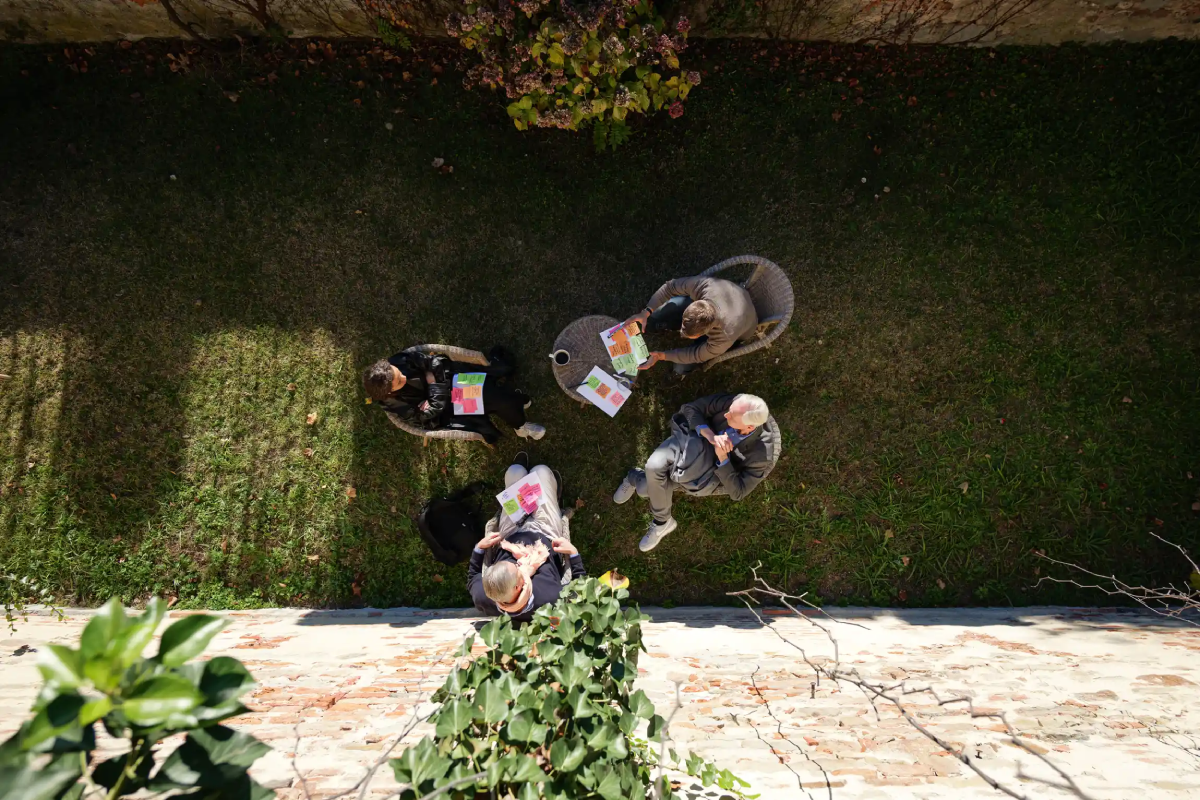
Unstructured Social: "Coffee & Comfy Chairs" for those who prefer spontaneous conversations over scheduled workshops.
How leaders pave the way
Model the Opt-Out: Culture starts at the top. If the CEO chooses quiet time over every activity, it signals to the team that they can, too. Being a team player is about presence, not constant participation.
Invest in “Anchor” Moments: While the day is flexible, the meals and evenings should be the unshakeable anchors. This is also where the campfire becomes the ultimate tool. It requires no WiFi, no moderator, and no forced participation, just a fire and a circle of chairs. People gravitate toward it naturally.
Ditch Audit Culture: Requiring "three key takeaways" ruins spontaneous connections. Trust bonding happens in silence and laughter. You don’t need to audit relationships to value them.
The ROI of Trust
Letting your team choose their experience says, "I trust your judgment." Trust creates psychological safety. Ending mandatory fun makes retreats enjoyable and organizations more mature, autonomous, and connected. A team isn’t a machine to calibrate, it’s an ecosystem to nurture. Stop trying to fix the people. Start fixing the environment.
Do You Love Checklist?
☐ Audit Your Itinerary
Does at least 30% of the daylight hours remain completely unassigned?
Are there gaps of at least 45 minutes between sessions? (15-minute breaks aren’t breaks; they’re transitions).
☐ Diversify Energy Levels
Have you provided at least one “High-Energy” (Active), one “Low-Energy” (Reflective), and one “Zero-Energy” (Rest) option for the same time slot?
Are the activities focused on shared experience rather than forced performance?
☐ Re-think Your “Anchor” Moments
Is the seating at meals conducive to small, organic groups rather than one giant, intimidating boardroom table?
Is there a central “meeting point” (like a campfire or lounge) that stays active without a scheduled start or end time?
☐ Brief Your Leadership
Have you told your leadership that “doing nothing” is a valid activity?
Are they prepared to lead by example by skipping an activity to have a quiet 1-on-1 coffee with a junior staffer instead?
☐ Eliminate the “Corporate Cringe”
Have you removed all icebreakers that require people to overshare or perform in front of a crowd?
Have you replaced “mandatory debriefs” with “available resources”?
☐ Verify the “Environment”
Does the venue allow for easy “escape”? (Can someone walk into the woods or to a private corner without feeling like they are leaving the group?)
Is the Wi-Fi strong enough to prevent “tech-anxiety,” but the setting beautiful enough to make them want to put the phone down?